

A Significant Shift in Market Correlation
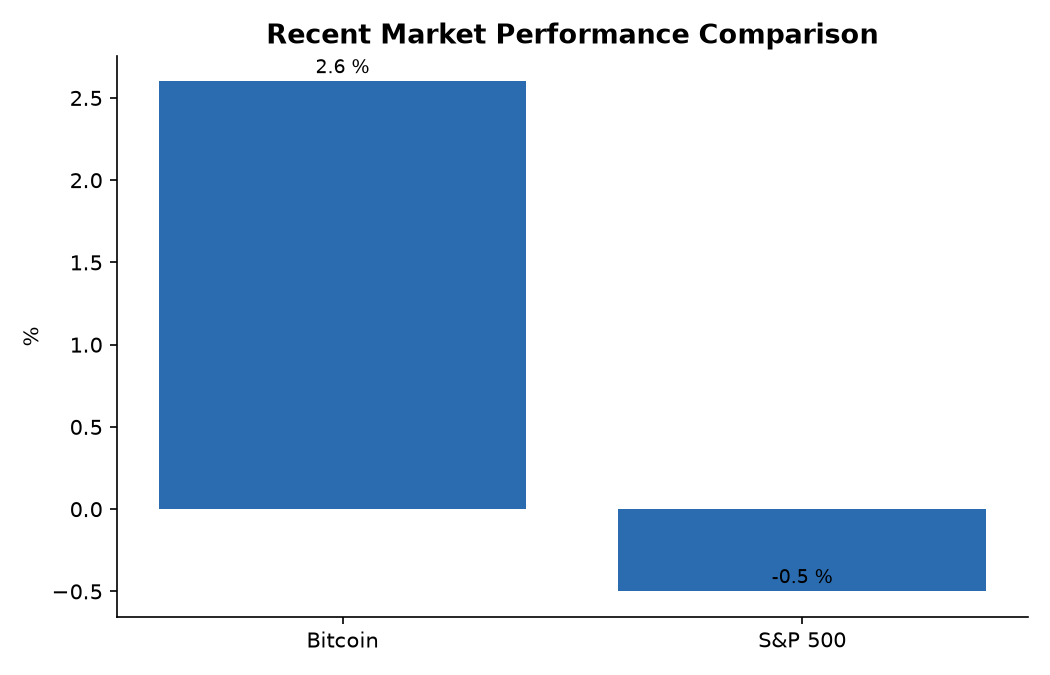
For much of the recent market cycle, investors have closely watched the correlation between Bitcoin and traditional equity benchmarks like the S&P 500. Historically, Bitcoin has often moved in tandem with high-risk tech stocks, acting as a proxy for global liquidity and risk appetite. However, a recent market session has broken this pattern, showcasing a rare moment of divergence.
While the S&P 500 recorded a minor decline, Bitcoin surged upward, proving its ability to find independent momentum. This decoupling is a critical metric for institutional investors who are increasingly looking at digital assets as a distinct asset class rather than a mere extension of the tech sector.
Analyzing the Performance Gap
The recent data reveals a stark contrast in movement. While traditional stocks faced downward pressure, the leading cryptocurrency saw a substantial uptick. This divergence is particularly noteworthy because it suggests that Bitcoin’s price action is being driven by specific crypto-native factors rather than purely following the macro-economic sentiment that dictates the movement of large-cap stocks.
Key Drivers of Divergence
- Liquidity Shifts: Capital may be rotating out of traditional equities and into the digital asset space seeking higher volatility and potential returns.
- Crypto-Specific Momentum: On-chain developments and ecosystem news often trigger price action that remains insulated from the quarterly earnings cycles of S&P 500 companies.
- Hedging Dynamics: Despite its volatility, the decoupling suggests that some market participants are utilizing Bitcoin for purposes distinct from traditional stock market hedging.
What This Means for Investors
For retail and institutional investors alike, this performance highlights the complexity of modern portfolio management. When Bitcoin moves independently of the S&P 500, it provides a unique opportunity for diversification. However, this independence also brings increased unpredictability, as investors can no longer rely solely on stock market trends to predict the direction of the crypto market.
As the digital asset landscape matures, these instances of divergence are likely to become more frequent, forcing a reevaluation of how digital assets fit into a diversified investment strategy.