

Why Prediction Markets Are Watching Congress Closely
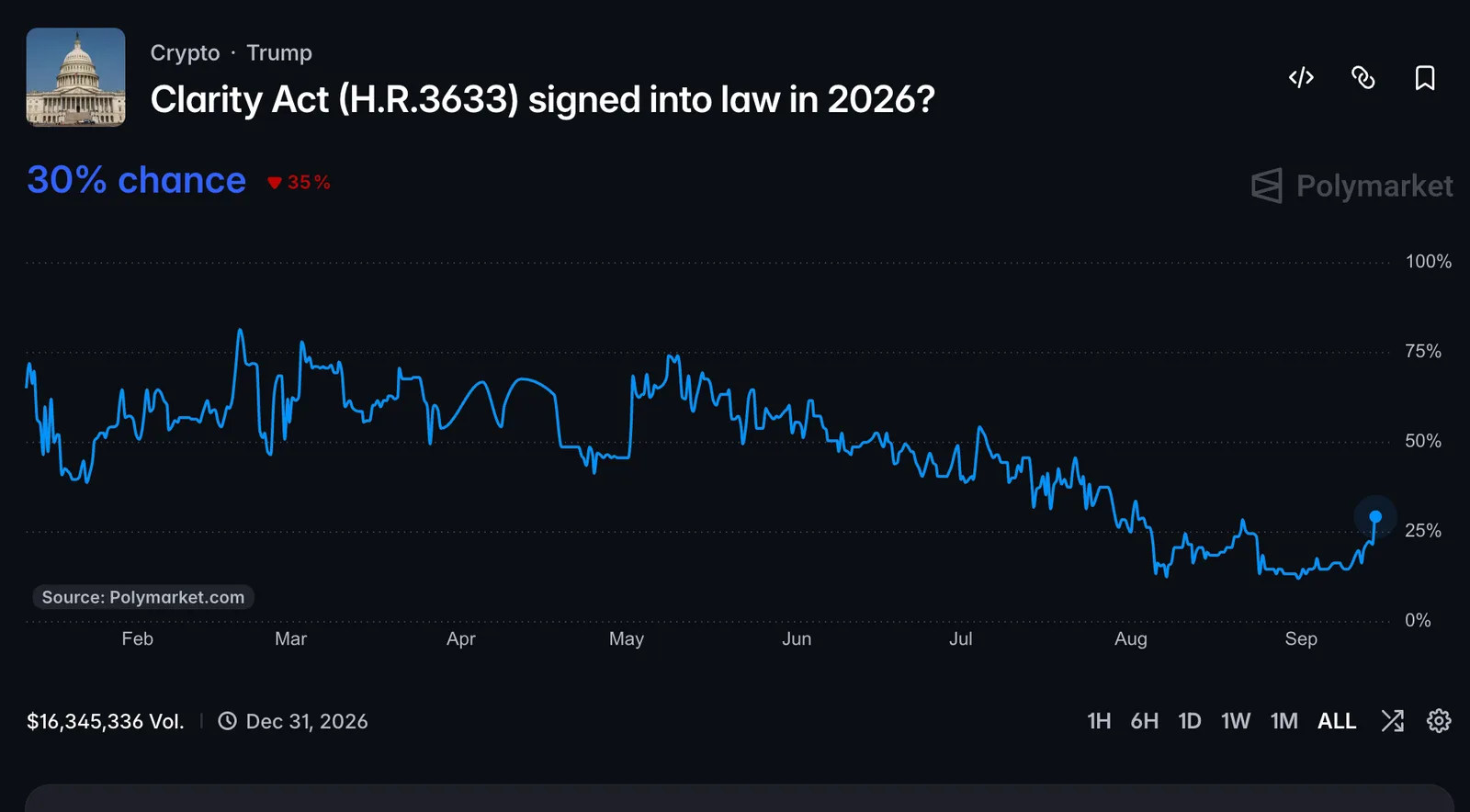
Prediction-market platforms have become a go-to barometer for political momentum on crypto policy. Over the past several weeks, contracts tied to the passage of major crypto bills have seen significant volume and rising odds, reflecting growing confidence among market participants that Washington may finally act on long-stalled digital-asset regulation.
These platforms function like real-money betting markets: participants buy and sell contracts tied to specific outcomes, and the resulting prices offer a live snapshot of collective sentiment. When odds climb rapidly, it usually signals that insiders, lobbyists, and political observers see a plausible window for legislative action.
The Clarity Act and the Broader Legislative Push
At the center of the current speculation is the Clarity Act, a piece of proposed legislation aimed at establishing a clear federal framework for digital assets. The bill seeks to define the regulatory roles of the Commodity Futures Trading Commission and the Securities and Exchange Commission when it comes to cryptocurrencies, stablecoins, and other crypto-native products.
Supporters argue that the United States risks falling behind global competitors if it fails to provide comprehensive rules for the industry. A structured regulatory environment, they contend, would encourage institutional investment, protect consumers, and reduce legal uncertainty that has held back mainstream adoption.
However, the word comprehensive is precisely where debates tend to stall. The Clarity Act has already undergone significant revisions to attract bipartisan support, but critics on both sides of the aisle remain unsatisfied. Some lawmakers want stricter consumer-protection provisions, while others push for a lighter-touch approach that would allow innovation to flourish with minimal federal interference.
What the Odds Surge Does — and Does Not — Mean
A jump in prediction-market odds is not a guarantee of passage. These markets are influenced by media coverage, political narratives, and short-term sentiment shifts just as much as by genuine legislative progress. A single high-profile hearing or a public endorsement from a key lawmaker can move prices dramatically without changing the underlying math in Congress.
Moreover, the U.S. legislative process is notoriously slow for complex, politically charged bills. Even measures with broad public support often languish in committee, get watered down during negotiations, or collapse entirely when election-year politics take over. Crypto legislation is no exception — if anything, its controversial nature and the intensity of lobbying on all sides make it especially vulnerable to delays.
What Investors Should Pay Attention To
For crypto market participants, prediction-market data offers a useful but incomplete signal. A rising probability of favorable legislation can boost sentiment and, in some cases, lift asset prices in the short term. But traders should keep several realities in mind:
- Odds reflect sentiment, not certainty. A 60% implied probability still leaves a meaningful chance of failure.
- Timing is unpredictable. Bills can be delayed by weeks or months with little advance warning.
- Final language matters more than introduction. A bill that passes in a heavily amended form may look very different from the version that first generated buzz.
Ultimately, the surge in prediction-market activity underscores just how much the crypto industry has come to depend on Washington’s next move. Whether that momentum translates into actual law will depend on factors far more complex than what any single market price can capture. For now, the smart play is to watch closely — but not to bet the farm.