

Why Ethereum Is Acting Before the Quantum Threat Arrives
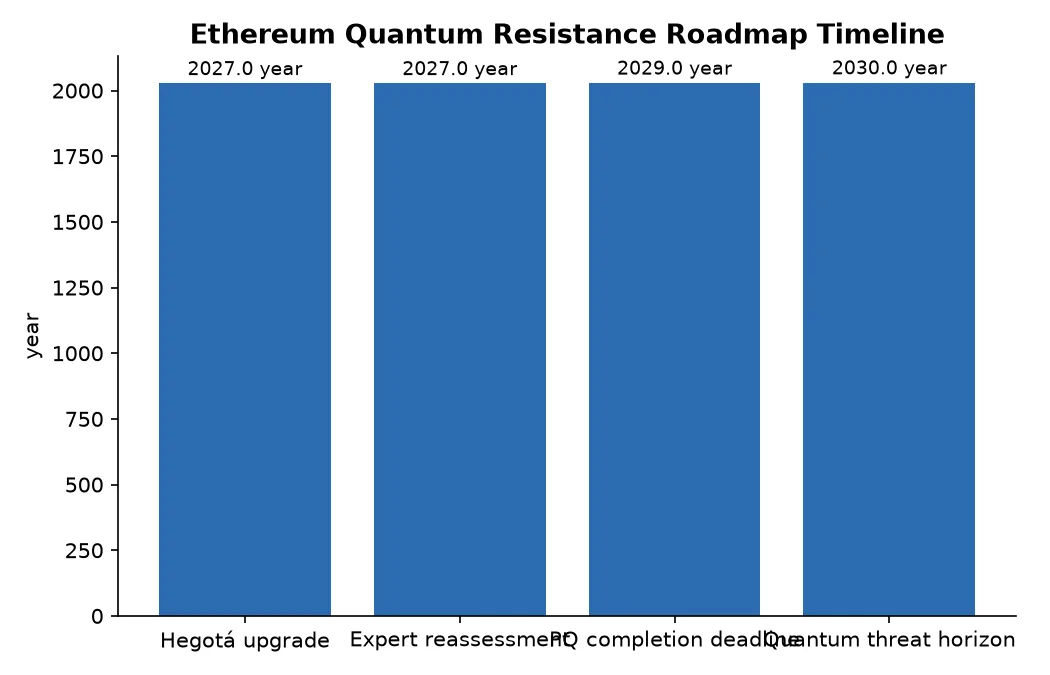
The Ethereum Foundation has committed to a December 2029 deadline for making the entire network resistant to quantum computers. The target covers every critical layer — from the signatures users sign to move funds, to the validator agreements that keep the chain secure, to the data stored onchain.
The date is deliberately ambitious. Credible forecasts place a quantum machine capable of breaking today’s encryption as early as 2030, and some researchers believe such a machine may never materialize. By setting the bar earlier, Ethereum is building a safety margin rather than racing to catch up.
How Quantum Computers Threaten Ethereum Today
Current quantum machines are nowhere near powerful enough to exploit Ethereum’s cryptography. But the vulnerability is structural: once a wallet sends a transaction, its public key is permanently visible on the blockchain. A sufficiently powerful quantum computer could theoretically reverse-engineer that public key to recover the private key and impersonate the owner.
The same risk applies to validators. Their signing signatures — the cryptographic proof that they agreed on the chain’s state — rely on the same math that quantum computers could eventually crack.
The Hegotá Upgrade: A Stepping Stone, Not the Solution
The upcoming Hegotá upgrade, slated for 2027, will not itself make Ethereum quantum-resistant. Instead, it is the gatekeeper that determines whether the subsequent post-quantum upgrades land on schedule. As the Foundation put it, Hegotá is the fork that decides whether the quantum-resistant forks happen on time.
Behind Hegotá sit three concrete proposals. Two would let accounts abandon secp256k1 — the signature scheme Ethereum has used since launch — as their master key. A third begins retiring validator withdrawal credentials still tied to that older system, extending a deposit contract redesign covered recently.
A Tight Schedule of Five Hard Forks
After Hegotá, five additional hard forks are planned, spaced roughly every 7.2 months. The Foundation acknowledges these cannot ship sequentially; they will need to overlap to stay on track. The milestones include leanSPHINCS, a hash-based signature scheme, post-quantum validator attestations, and a public key registry.
A fallback mechanism — minimum viable post-quantum protection — is also in the roadmap. It would keep the network operational through a quantum breakthrough with reduced guarantees if the full rebuild is not complete in time.
What Changes for Developers and Users
The fixed deadline reshapes prioritization. Features entering upcoming upgrades are no longer competing only against each other for developer attention; they are measured against a hard date for replacing cryptography that Ethereum expects will eventually become obsolete. External technology firms — including Google, Cloudflare, and Microsoft — have set migration targets around the same window, suggesting the industry is converging on a shared timeline.
Outside experts will reassess the pace of quantum progress by January 2027, offering a checkpoint before the final push. For now, users face no immediate risk, but the groundwork being laid today will determine whether Ethereum survives the quantum era intact.