


Start With Purpose, Not a Prompt
Charitable giving often arrives as a series of small interruptions: a school fundraiser, a community appeal, a disaster response, or a checkout donation request. Each gift may be worthwhile, but reacting to every appeal can leave you wondering whether your giving reflects your actual priorities.
A better approach is to decide what you want your generosity to support before the next fundraising season begins. Intentional giving is not about giving less. It is about making sure your donations are connected to causes you care about and an outcome you can evaluate.
Choose a Small Set of Core Causes
Start by identifying one or two areas that matter most to you. Youth programs, animal welfare, education, religious communities, health services, and local mutual aid can all be valid priorities. The right choice depends on your values, your community, and the change you hope to help create.
Once you have selected a cause, research the organizations serving that space. Review their mission, reported results, financial statements, and accountability practices. You do not need to become a professional analyst, but you should look beyond an emotional appeal and ask whether the organization uses its resources effectively.
Match Giving to Your Financial Capacity
Your giving budget should begin with your personal finances. High-interest debt, an inadequate emergency fund, a major upcoming purchase, education costs, or insufficient retirement savings can all reduce the amount you can give comfortably.
A donor in peak earning years may have more flexibility than someone managing several financial pressures. That difference does not determine who is more generous; it affects how much giving is sustainable. A realistic annual target is more useful than an impressive promise made under pressure.
Understand How the Tax Benefit Works
A charitable gift does not automatically reduce your tax bill by the same amount. A deduction generally lowers taxable income, so its value depends on whether you take the standard deduction or itemize, your income level, and your marginal tax rate.
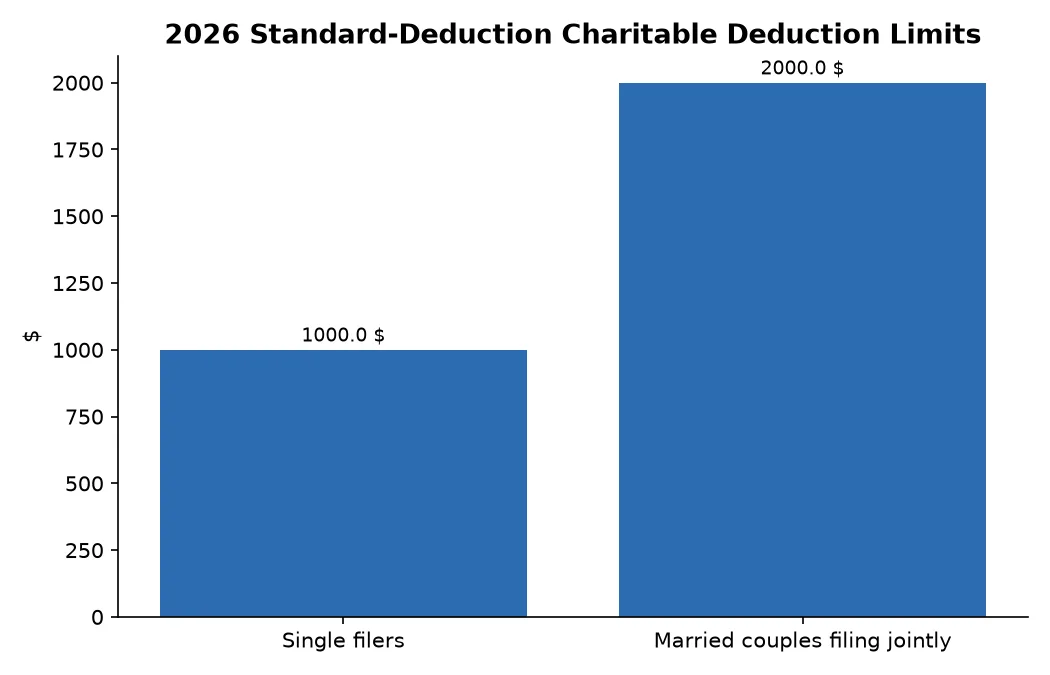
For the 2026 tax year, the standard deduction is $16,100 for single filers and $32,200 for married couples filing jointly. Under the law enacted July 4, 2025, taxpayers using the standard deduction can deduct qualifying charitable gifts up to $1,000 for single filers and $2,000 for married couples filing jointly.
Itemizers face different rules. The first 0.5% of adjusted gross income in charitable giving is not deductible, and taxpayers in the top bracket receive a federal benefit capped at 35% rather than 37%. For example, someone with $500,000 of AGI and $20,000 in qualifying gifts would have $2,500 excluded from the deduction. The remaining $17,500 could produce about $6,125 in federal tax savings at the 35% rate.
Consider Bunching, but Do Not Stretch the Budget
Bunching means combining two or three years of planned gifts into one tax year. This can help a donor reach a level of giving that makes itemizing worthwhile. It works only when the cash is genuinely available, however. Moving a donation forward is not helpful if it creates financial strain or forces you to borrow.
Keep the Documentation Needed for a Deduction
To claim a charitable deduction, the recipient must have qualifying 501(c)(3) status. A contribution to a friend’s crowdfunding page may be generous, but it is not necessarily tax-deductible. For gifts of $250 or more, keep a formal acknowledgment from the charity confirming the donation and stating whether you received goods or services in return.
Measure Success by Alignment and Impact
The most useful question is not simply whether you gave enough. Ask whether your giving plan reflects your values, supports organizations you have reviewed, and fits your financial life. A smaller number of thoughtful donations can create more lasting value than scattered gifts made in response to the latest appeal.
Because tax rules and individual circumstances vary, review your plan with a qualified tax professional before making large gifts or changing your filing strategy.