


Breaking the 1,232-Byte Ceiling
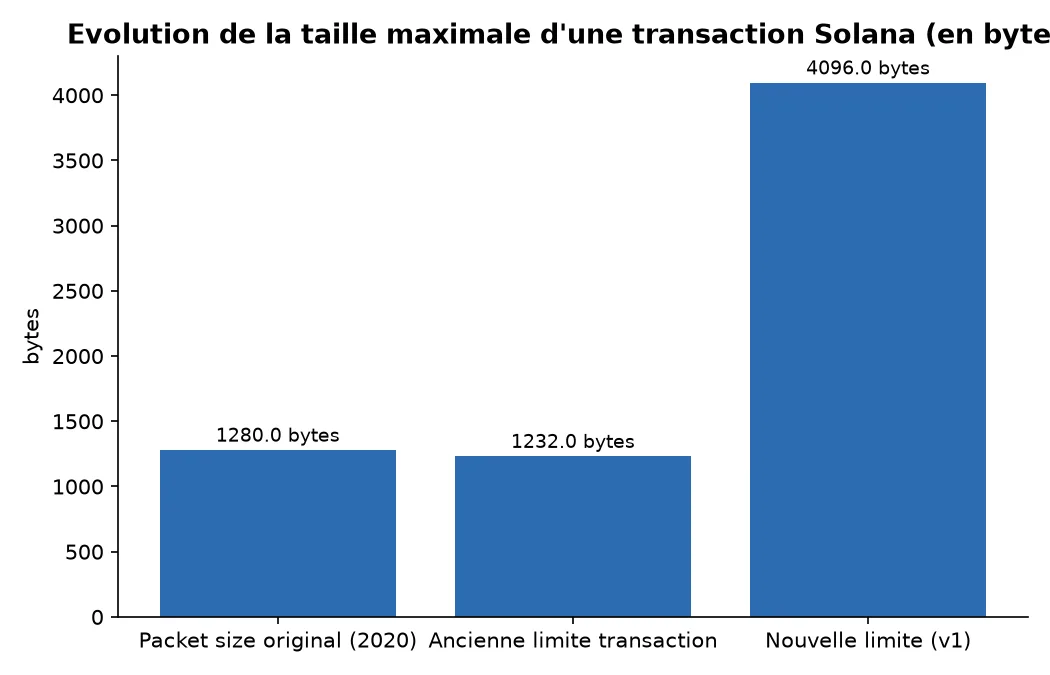
Since its launch, Solana has imposed a strict upper bound on transaction size: 1,232 bytes. That cap originated in the network’s original networking design, where each transaction had to fit inside a roughly 1,280-byte internet data packet. Over time, that constraint became a competitive weakness. While Solana excelled at speed and low cost, developers working on data-heavy applications — large cryptographic proofs, multi-party payments, confidential transfers — were forced to split operations across multiple transactions, adding complexity and user friction.
The new « Transaction v1 » format changes that. By raising the ceiling to 4,096 bytes, Solana gives developers more than three times the payload space in a single operation. Many workflows that previously required two, three, or more separate transactions can now be consolidated into one.
Why 4,096 Bytes?
The choice of 4,096 bytes is not arbitrary. Four kilobytes is a standard memory-page size used by validator hardware. Pushing the limit significantly higher would force a single transaction to span multiple memory pages, making it more expensive for the machines that process blocks. The upgrade also reflects a broader infrastructure shift: Solana changed how transaction traffic is transmitted in 2022, making the old 1,280-byte packet ceiling less relevant.
Competing with Ethereum on Flexibility
Ethereum has no rigid protocol-level transaction size limit. Developers can include as much data as they want in a single transaction, paying a higher fee to compensate. This flexibility has attracted builders of data-dense applications — from zero-knowledge proof systems to complex DeFi strategies. Solana’s new ceiling does not match Ethereum’s open-ended model, but it eliminates the most glaring structural gap between the two networks.
Software Updates Required
The transition is not seamless for every participant in the ecosystem. Services that fetch and index blocks and transactions need to recognize the v1 format; otherwise, requests fail when they encounter it. Wallets, block explorers, and trading platforms that depend on these indexing services could display incorrect information if their backend software is not updated.
Priority fees — optional tips users pay to speed up processing — are stored differently under v1. Outdated software may show a zero fee even when one was paid, creating a mismatch between what users see on screen and what actually occurred on-chain.
No New Per-Byte Fee
The upgrade does not introduce a fee structure based on transaction size. However, larger transactions consume more network bandwidth, and developers expect users may need to offer higher priority fees when their transactions compete for limited block space during periods of congestion.
Governance Context
The size increase is defined in two proposals, SIMD-0296 and SIMD-0385, and is entirely separate from recent governance votes that adjusted how quickly new SOL enters and exits circulation through network fees.