


The Perils of ‘Tax-Driven’ Investing
For many real estate investors, the decision to sell a property is met with an automatic reflex: the 1031 exchange. On paper, it is a powerhouse strategy that allows you to defer capital gains taxes indefinitely, keeping more capital working within your portfolio. However, a dangerous phenomenon occurs when the desire to avoid a tax bill dictates the investment choice, rather than the quality of the asset itself.
When investors are rushed by strict identification timelines—often just 45 days—they may find themselves forced to purchase overpriced or low-yielding properties simply to satisfy the IRS. This creates a scenario where the ‘tax tail is wagging the investment dog.’ Before committing, an investor must ask: If I ignored the tax implications entirely, would I still want to own this replacement property?
Comparing the Math: Tax Deferral vs. Liquid Cash
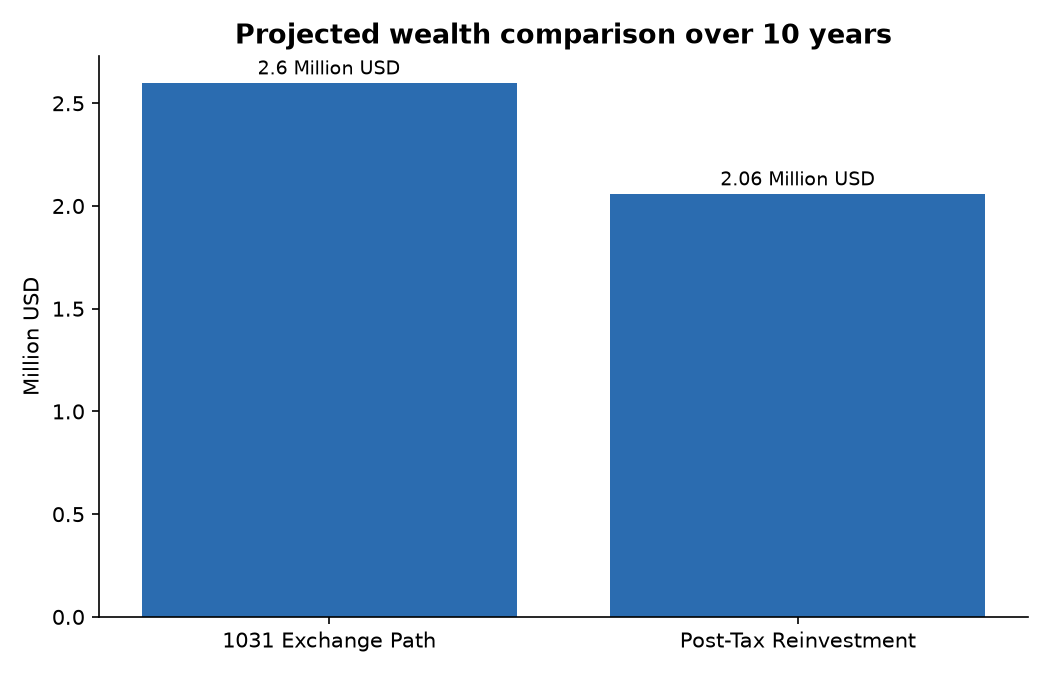
To understand the weight of this decision, consider a scenario where an investor sells a property with a significant capital gain. The choice is between paying the tax now and reinvesting the remaining cash, or reinvesting the full pretax amount into a new asset.
While the 1031 exchange typically results in higher total wealth over a decade due to the power of compounding pretax dollars, it comes with strings attached. You aren’t just deferring a tax; you are deferring your exit from the responsibilities of property ownership. For many, the complexity of managing new tenants and maintenance becomes a burden they no longer desire.
The Passive Alternative: Delaware Statutory Trusts (DST)
For investors who want to maintain their tax-deferred status but are ready to retire from active management, the Delaware Statutory Trust (DST) offers a strategic middle ground. A DST allows you to exchange your equity into fractional ownership of institutional-grade real estate. This provides several key benefits:
- Professional Management: You own a piece of a high-quality asset, but a professional sponsor handles all operations, maintenance, and leasing.
- Passive Income: You receive regular distributions without the headaches of being a landlord.
- Preserved Deferral: The full benefits of the 1031 exchange remain intact.
The Ultimate Exit: Estate Planning and Stepped-Up Basis
It is vital to view 1031 exchanges through the lens of estate planning. One of the most significant advantages of holding appreciated real estate until death is the ‘tepped-up basis.’ This mechanism allows heirs to inherit the property at its current fair market value, effectively wiping out the deferred capital gains entirely.
Because of this, the decision to exchange should be part of a broader conversation involving your age, health, and long-term legacy goals. For those looking for simplicity and liquidity, paying the tax might be the cleanest path. For those looking for growth and legacy, the 1031 into a DST might be the superior evolution of their portfolio.