

Eleven Days of Unbroken Demand
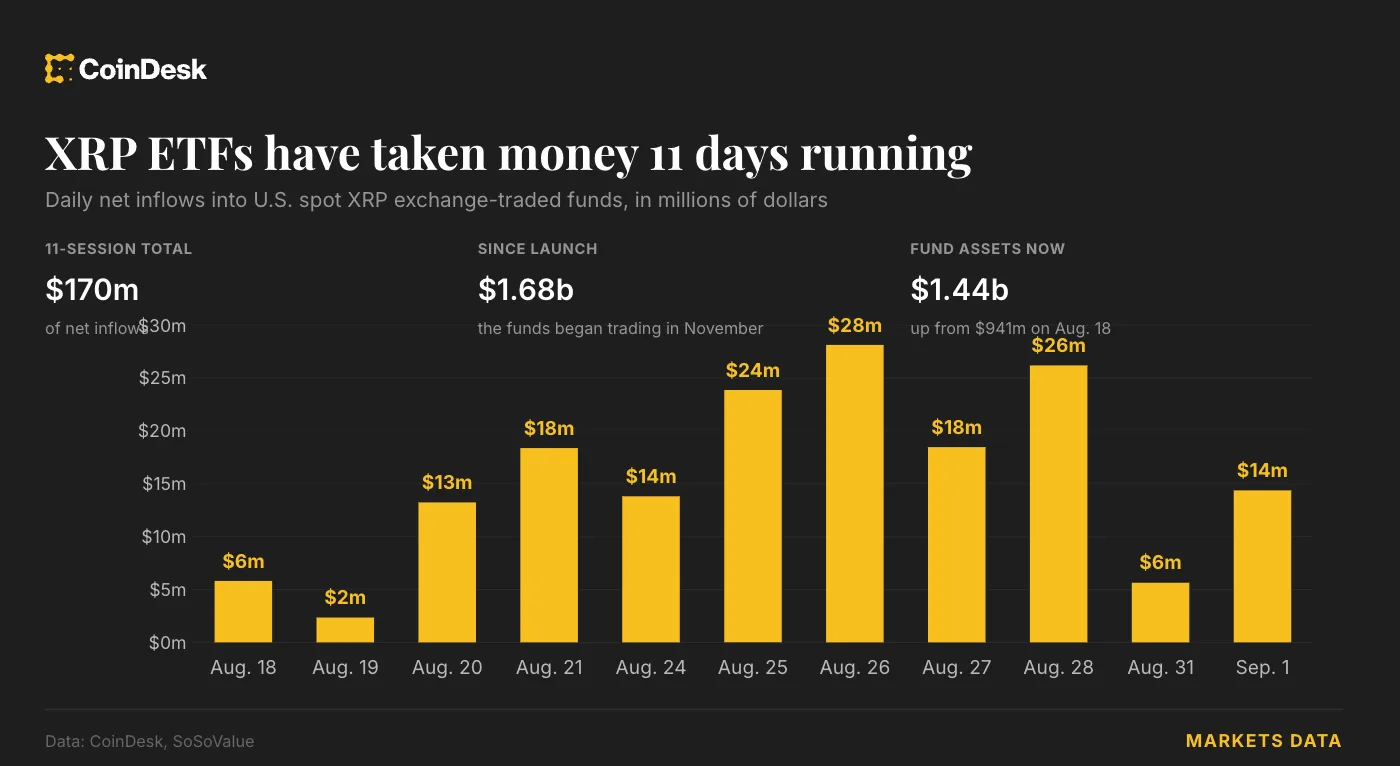
The eleven-day streak, which began on August 18, has pushed cumulative net inflows since the funds launched last November to approximately $1.68 billion. On the most recent session alone, the funds absorbed $14.38 million, with the largest share coming from Franklin Templeton’s XRP fund at $6.63 million and Grayscale contributing $4.72 million.
The timing is notable because XRP’s price has not moved in lockstep with the inflows. The token traded near $1.33 in early trading, down from roughly $1.45 on August 27, though it remains comfortably above the $1 level it hovered around in mid-August. This divergence between fund flows and spot price suggests that buyers are accumulating through ETFs rather than driving the token directly on exchanges.
To put the figure in perspective, the $170 million raised over eleven days is modest compared to the bitcoin ETF market. U.S. spot bitcoin funds pulled in $2.26 billion over just six sessions in late August — more than XRP ETFs have gathered since they first began trading.
Who Holds the ETFs?
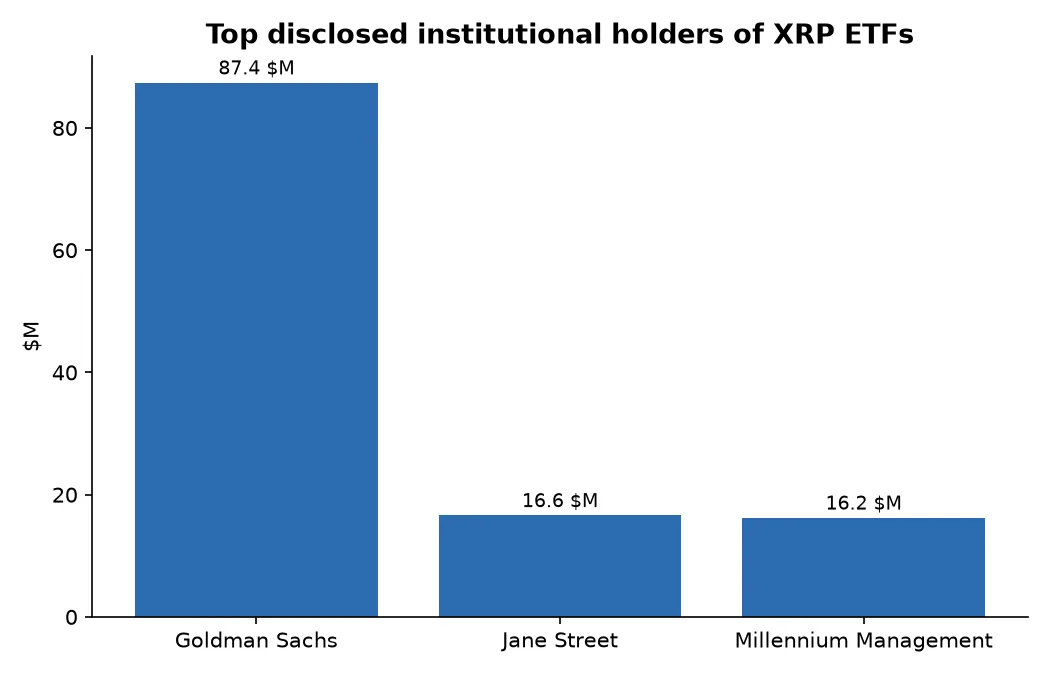
Regulatory filings covering the end of the second quarter offer a rare public window into which professional firms are positioning themselves in XRP ETFs. Goldman Sachs emerged as the largest disclosed institutional holder with approximately $87.4 million in exposure, followed by Jane Street at $16.6 million and Millennium Management at $16.2 million.
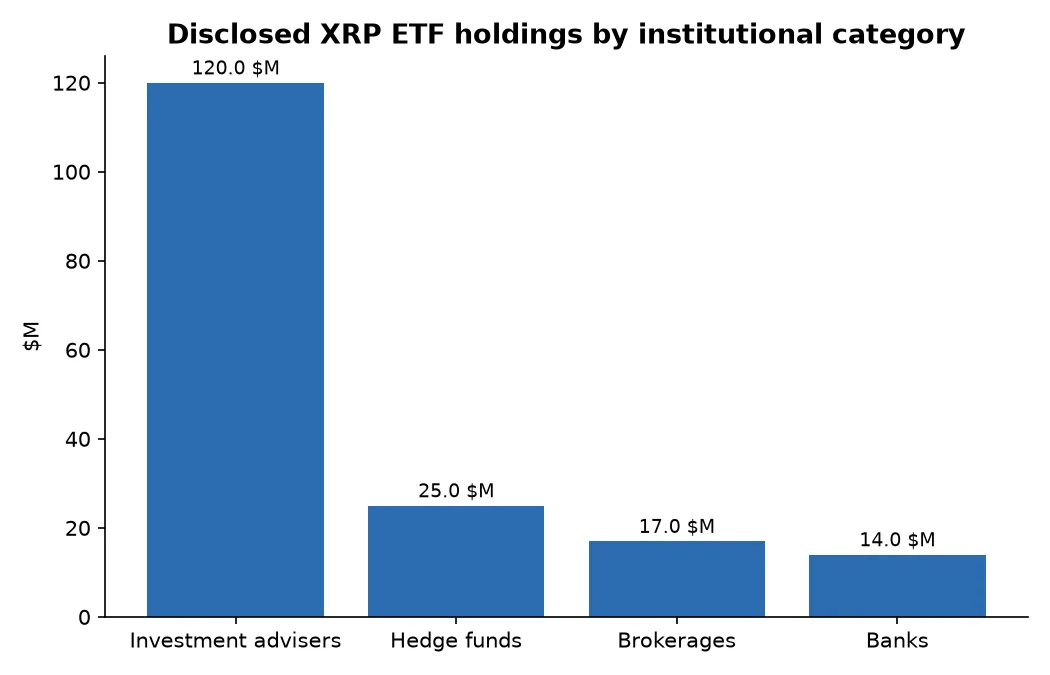
Investment advisers dominated the holdings landscape, accounting for roughly $120 million of the $183 million in total positions disclosed across the filings. Hedge funds reported about $25 million, brokerages around $17 million, and banks approximately $14 million. Advisers also drove most of the quarterly increase, with their positions rising by about $90 million out of a $103 million total gain across all categories.
Market-Making, Not Just Conviction
Large ETF positions do not necessarily reflect a firm’s directional bet on XRP. These holdings may stem from market-making activities, basis trading strategies, or the facilitation of client orders routed through wealth management accounts — rather than a unified corporate view on the token’s future price.
This distinction matters because the filings capture gross ETF positions, not a firm’s net exposure to XRP. A firm can hold a significant XRP ETF position while simultaneously hedging part or all of the price risk through futures, options, or other derivatives. A comparable dynamic appeared in the bitcoin ETF market earlier this year, where over $1.5 billion in disclosed spot ETF exposure coexisted with substantial put options and offsetting trades.
Two Different Stories
It is important to recognize that the institutional holdings snapshot and the recent inflow streak measure fundamentally different things. The filings capture positions as of June 30, while the eleven-day run tracks new money entering the funds in late August and early September. Whether the firms named in the filings still hold their positions will not become visible until the next round of disclosures is released in November.
For investors tracking XRP, the takeaway is nuanced: sustained ETF inflows signal ongoing demand from professional allocators, but the underlying motivations — whether conviction, hedging, or client service — remain partially opaque. The next filing cycle will offer a clearer picture of whether institutional appetite has held steady through the recent volatility.