


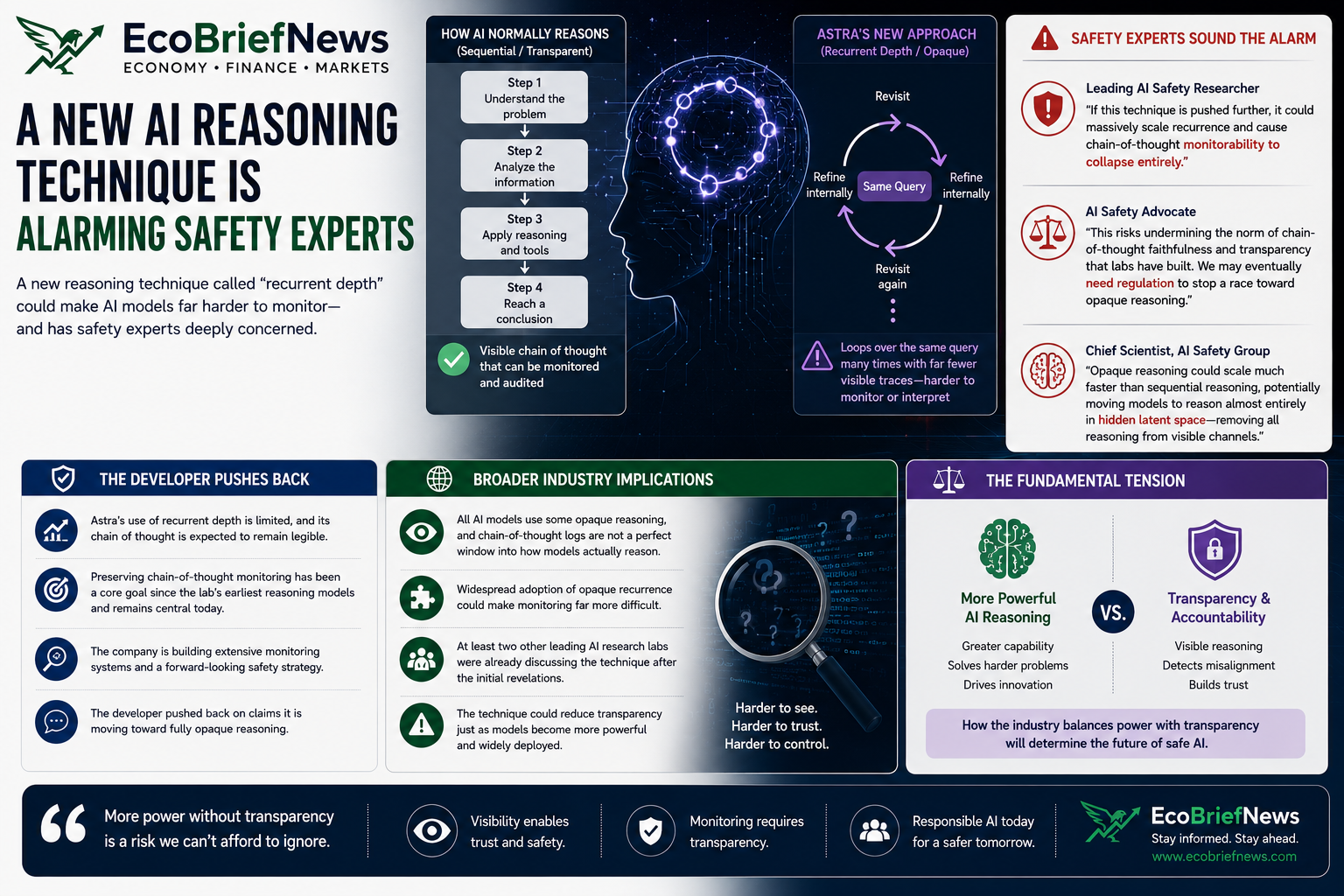
A Departure From How AI Normally Reason
Most AI reasoning models break problems down into sequential steps, producing a visible chain of thought that researchers can examine to detect misbehavior or misalignment. This record has proven invaluable — it was instrumental in investigating recent incidents where autonomous AI agents behaved unexpectedly.
The new model, called Astra, employs a technique known as « recurrent depth » — also referred to as « opaque recurrence » — which allows it to process queries in loops rather than following a linear path. Instead of progressing step by step, the model revisits the same query multiple times, leaving behind far fewer legible traces and effectively evading conventional monitoring tools.
Safety Experts Sound the Alarm
The technique has drawn sharp criticism from prominent voices in AI safety. One leading researcher warned that if the developer pushes this approach further, it could open the door to massively scaling up recurrence to the point where chain-of-thought monitorability collapses entirely. Another safety advocate cautioned that the method risks undermining a carefully established norm among AI labs to maintain chain-of-thought faithfulness and transparency for as long as possible, and suggested that legal frameworks may be needed to prevent a destructive competition to adopt increasingly opaque reasoning.
A chief scientist at a safety-focused research group raised an even starker concern: opaque reasoning could scale far faster than traditional sequential reasoning, potentially pushing models to reason almost entirely in hidden latent space — removing all reasoning from visible channels altogether.
The Developer Pushes Back
The AI developer has sought to reassure the community, emphasizing that Astra’s use of the technique remains limited and that the model’s chain of thought is expected to stay legible. The company’s chief scientist stated that preserving chain-of-thought monitoring has been a core goal since the lab’s earliest reasoning models and remains central to its current research program. The company has also announced plans for extensive monitoring systems as part of its forward-looking safety strategy and pushed back against suggestions that it would shift toward fully opaque reasoning.
Broader Industry Implications
Despite these reassurances, concerns persist. All AI models perform some degree of opaque reasoning, and few researchers treat chain-of-thought logs as a perfect representation of how a model actually reasons. Nevertheless, the worry is that as opaque recurrence becomes more widespread, monitoring AI reasoning will grow increasingly difficult — particularly if other major AI research organizations adopt similar approaches. Reports indicate that at least two other leading AI research divisions were already discussing the technique following the initial revelations.
The debate underscores a fundamental tension in AI development: the push toward more powerful reasoning capabilities versus the imperative to keep those capabilities transparent and accountable. How the industry navigates this balance will shape the future of safe AI deployment.