

July’s Surprise Drop Sets a Low Bar
The U.S. economy shed 23,000 jobs in July, a stunning reversal from the 85,000 positions economists had anticipated. Compounding the weakness, downward revisions to May and June data erased another 103,000 jobs from previously reported totals. The disappointing figures have raised questions about whether the labor market is cooling faster than expected — or whether seasonal quirks distorted the picture.
Federal Reserve officials have characterized the labor market as broadly stable, noting that the unemployment rate remains near historic lows. Yet the soft payroll numbers have introduced fresh uncertainty ahead of the August release scheduled for September 4.
Early Signals From the Private-Sector Report
Private-sector hiring data released before the official government report offered a mixed signal. Payroll processing data showed employers added 38,000 positions in August, down from 46,000 in July and below the 47,000 economists had projected. Education, health care, leisure and hospitality, and construction led gains, while manufacturing continued to shed jobs.
What Economists Are Saying
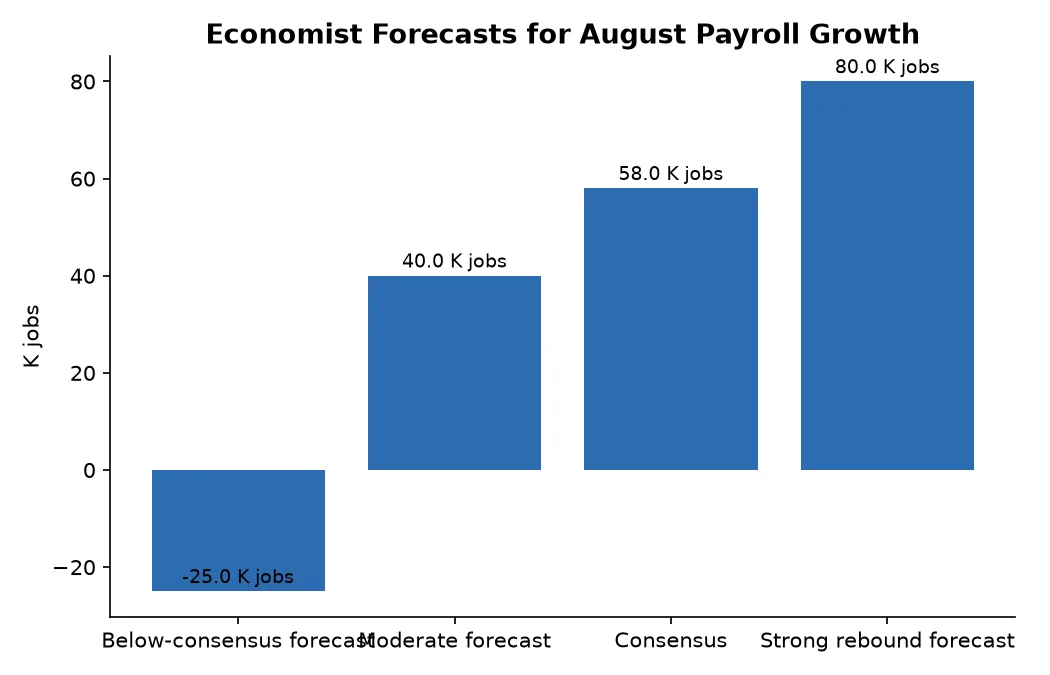
Forecasts for August span an unusually wide range, reflecting genuine disagreement about the labor market’s trajectory:
- Some analysts project a contraction of around 25,000 jobs, citing immigration policy changes that may have reduced payroll counts.
- Others expect a rebound to roughly 80,000, arguing that July’s weakness was exaggerated by temporary factors in leisure, hospitality, and government education.
- The consensus forecast sits near 58,000 new positions, with the unemployment rate expected to hold at 4.1%.
Several strategists have noted that slower labor-force growth — down by 1.3 million workers over the past year — may be masking underlying demand. If fewer people are competing for jobs, softer payroll gains do not necessarily signal economic weakness.
Implications for the Fed and Investors
The Federal Reserve has signaled that inflation remains its primary concern, and a single jobs report is unlikely to trigger a policy shift on its own. However, a significantly stronger-than-expected reading could revive debate over rate increases, while a much weaker print might strengthen the case for holding rates steady.
For investors, the divergence in forecasts underscores the importance of diversification. Some strategists are pointing toward commodities such as oil, gold, and silver as hedges in an environment where rates may stay elevated for an extended period.
Ultimately, the August jobs report will serve as a critical piece of the puzzle for policymakers and markets alike. Whether the labor market is cooling gradually or accelerating its slowdown, the data will help define the economic narrative heading into the final quarter of the year.