


A Regulatory Standoff Over Crypto Derivatives
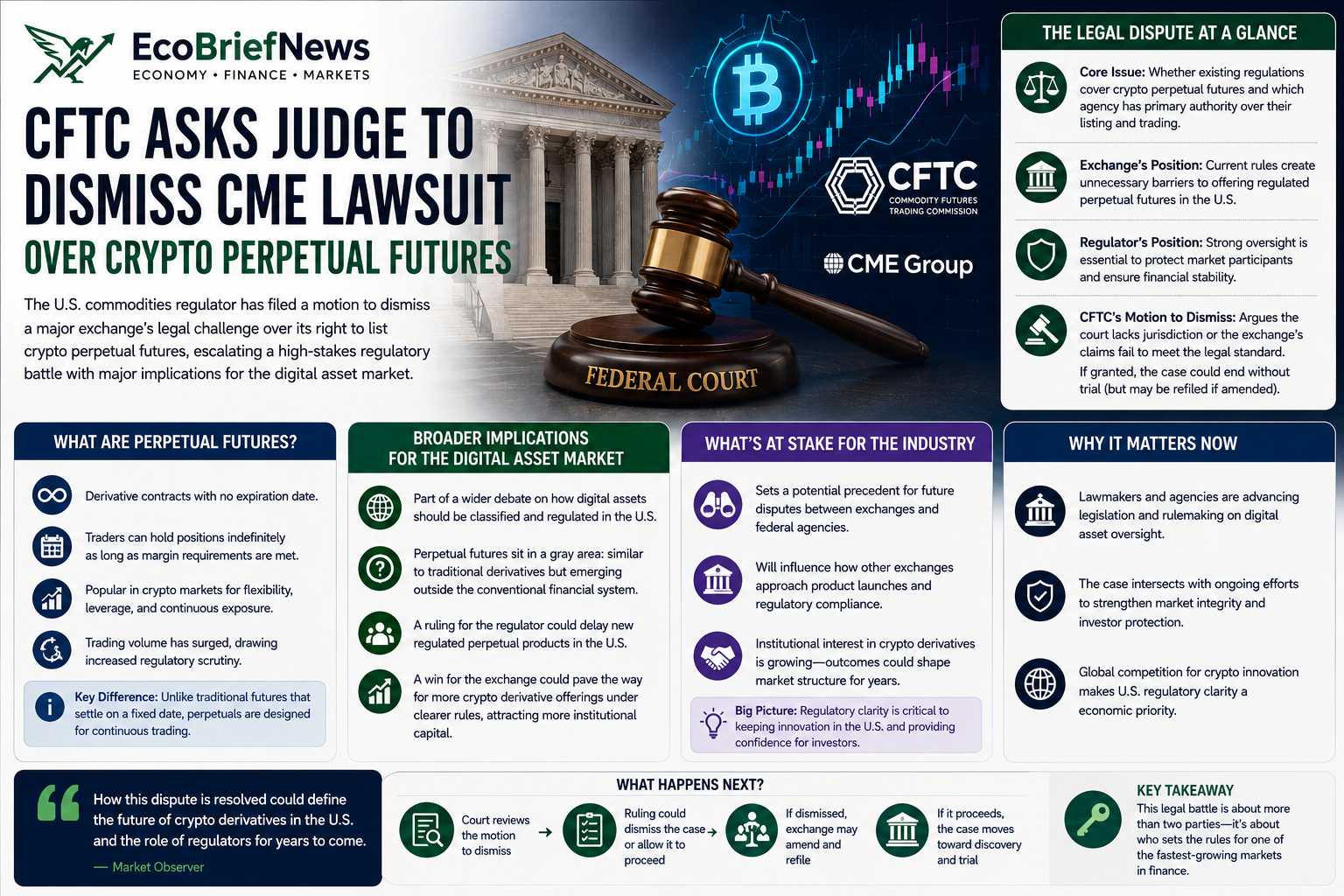
The regulatory battle over cryptocurrency perpetual futures has intensified after the federal commodities regulator filed a motion to have a major exchange’s legal challenge dismissed. The filing represents a significant escalation in the ongoing tension between market operators and federal oversight bodies over how digital asset derivatives should be governed.
What Are Perpetual Futures and Why Do They Matter?
Perpetual futures — a type of derivative contract popular in crypto markets that lacks an expiration date — have become one of the most actively traded products in digital assets. Unlike traditional futures, which settle on a fixed date, perpetual contracts allow traders to hold positions indefinitely, provided they meet margin requirements. The product has drawn increasing attention from regulators as its trading volume has surged globally.
The Legal Dispute at a Glance
The core of the disagreement centers on whether the existing regulatory framework adequately covers these instruments and which authority holds primary jurisdiction over their listing and trading. Exchanges seeking to offer regulated perpetual futures products in the U.S. have argued that current rules create unnecessary barriers, while regulators maintain that robust oversight is essential to protect market participants and ensure financial stability.
The regulator’s motion to dismiss signals confidence that the court lacks jurisdiction or that the exchange’s claims do not meet the legal threshold for proceeding. Legal analysts note that such motions are procedural tools that, if granted, end a case without trial — but they can be refiled if the plaintiff amends its complaint. The outcome of this filing could set a precedent for how similar disputes between exchanges and federal agencies are resolved in the future.
Broader Implications for the Digital Asset Market
This legal clash unfolds against a broader backdrop of evolving cryptocurrency regulation in the United States. Lawmakers and agencies have been grappling with how to classify and supervise digital asset products that do not fit neatly into existing financial frameworks. Perpetual futures occupy a particularly gray area: they resemble traditional derivatives but operate in a market structure that developed largely outside the conventional financial system.
For market participants, the case carries practical consequences. A ruling in favor of the regulator could reinforce the current oversight structure and potentially delay the introduction of new regulated perpetual products on domestic platforms. Conversely, if the exchange’s challenge succeeds, it could open the door to a wider range of crypto derivative offerings under clearer rules — potentially attracting more institutional capital into the space.
What’s at Stake for the Industry
The broader digital asset industry has been watching closely, as the resolution of this dispute may influence how other exchanges approach product launches and regulatory compliance. With institutional interest in crypto derivatives continuing to grow, the stakes extend well beyond the two parties involved in this particular case.
Market observers also note that regulatory clarity around crypto derivatives has become a priority for lawmakers seeking to keep innovation within U.S. borders rather than ceding ground to offshore platforms. The interplay between litigation, rulemaking, and congressional action will likely shape the trajectory of digital asset markets for years to come.