


The Problem: Too Much Content, Nowhere to Find It
Every day, professionals generate staggering amounts of video recordings, meeting transcripts, images, and documents. While generative AI has made content creation easier than ever, it has also made the resulting digital clutter far harder to manage. Adobe, Apple, and Google are all embedding AI search into their own ecosystems, but a new wave of startups argues that a dedicated, cross-platform tool is still missing.
Clipto is placing that bet. The company has built a desktop application that indexes videos, audio files, images, meeting recordings, and documents stored on a user’s machine — and lets people find anything by simply describing what they need in plain language, or by routing the query through tools like ChatGPT or Claude.
How Clipto Works — and Why It Stands Out
Unlike built-in search features from tech giants, which tend to work only within their own walled gardens, Clipto spans multiple file types and storage locations. Users can search across videos, audio, images, and documents in one query. The company also lets users selectively expose indexed content to external AI agents, with all processing happening locally on the device rather than in the cloud.
About two weeks ago, Clipto added support for the Model Context Protocol, a standard that lets AI applications connect with outside data sources. According to founder Henry Kang, any access to indexed files requires explicit user authorization, and retrieved information is limited to whatever scope the user defines.
From Video Creators to Every Professional
Clipto initially targeted video creators juggling footage across computers and external drives. Today, however, creators account for only about one-quarter to one-third of its user base. The rest includes lawyers, doctors, researchers, marketers, HR professionals, professors, and students — a sign that the product has broadened well beyond its original niche.
Kang’s connection to this problem runs deep. While pursuing a PhD at Carnegie Mellon University in 2006, he worked on robots that recorded their surroundings, identified objects, and remembered where to find them. He later applied that same core concept to a closet-management startup and then ZenVideo, a video-creation tool acquired by Tencent in 2020.
Funding and Financial Snapshot
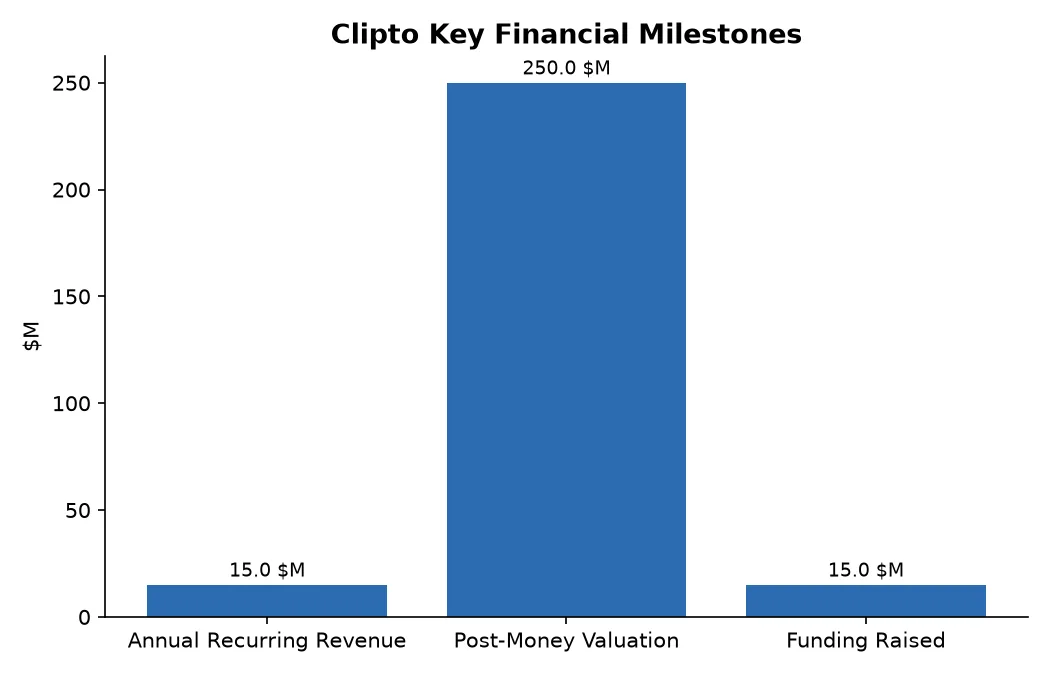
Clipto closed an all-equity round valuing the company at $250 million post-money. The $15 million investment drew participation from HSG, GL Ventures, EnvisionX Capital, Palm Drive Capital, 522 Ventures, and individual investors Hans Tung and Lu Zhang.
The company reached $15 million in annual recurring revenue at the start of 2026 and remains profitable on a net-income basis. With just over 20 employees spread across the San Francisco Bay Area, Hong Kong, and Singapore, Clipto plans to channel the new capital into AI models and computing infrastructure capable of running on consumer hardware, along with deeper integrations with AI agents.
Competing Against Tech Giants
Clipto enters a market where Adobe offers AI search inside Premiere, and Apple Photos and Google Photos let users find media with natural-language queries. Kang argues that those solutions remain confined to their respective platforms, whereas Clipto unifies search across file types and makes selected data accessible to third-party AI tools — a combination the company hopes will help it hold its ground against much larger competitors.