

The professor who built a $4 billion biotech bet
Vijay Pande’s origin story reads like a crossover novel. A Stanford chemistry professor best known for founding Folding@home — a distributed-computing project that harnessed millions of home computers to simulate protein folding for disease research — he was hardly a household name in finance. That changed when Marc Andreessen and Ben Horowitz, whose firm had spent its first half-decade steering clear of healthcare, decided the sector deserved a serious wager and handed Pande the reins.
Over the next twelve years, he transformed that single bet into a full-scale practice managing close to $4 billion. Drug discovery, clinical trials, precision medicine — Pande’s portfolio became synonymous with the intersection of artificial intelligence and life sciences.
Walking away to bet smaller
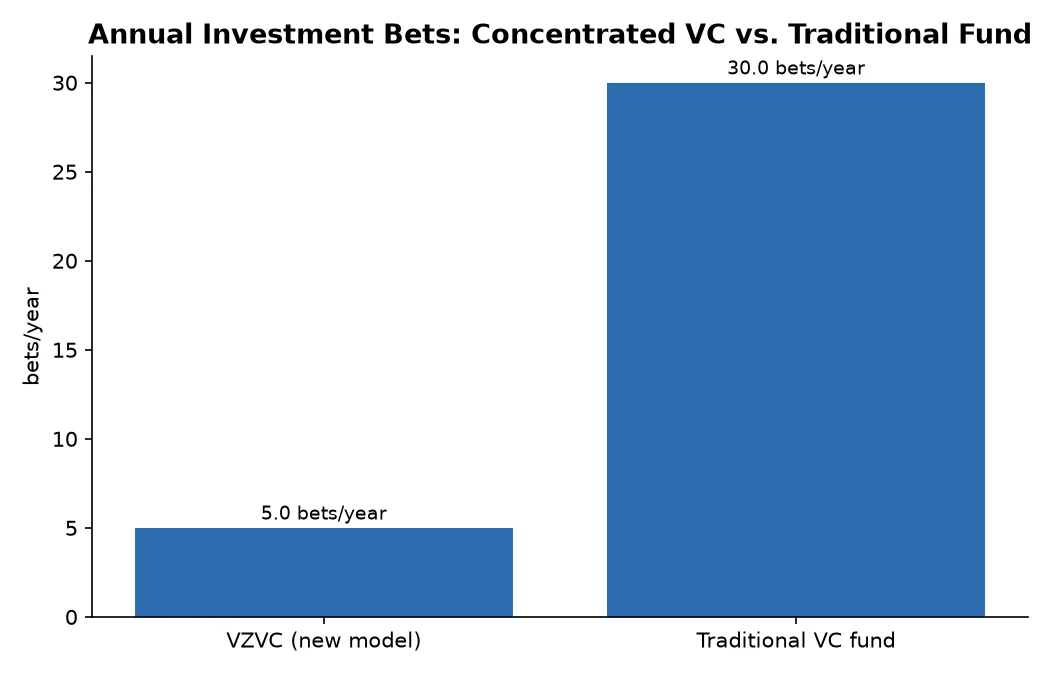
In June of last year, Pande did something unexpected. He left the giant behind and co-founded VZVC with longtime investor Zack Werner. The new firm operates on a philosophy that flips the conventional VC playbook: instead of spreading capital across dozens of companies, VZVC makes roughly five concentrated investments per year, employs no associates, and leans heavily on custom-built AI agents for its day-to-day operations.
« We’re not driving 30 bets per year — we’re talking about probably five, » Pande explained. He drew a vivid analogy: adding a company to a traditional fund is like adding a Facebook friend — quick and casual. For him and Werner, it’s more like wanting another child. Every investment is a deliberate, long-term commitment.
Why concentration is the new strategy
The logic behind VZVC’s lean model is straightforward: in a market flooded with capital chasing the same hot Series A and Series B rounds, differentiation comes from depth, not breadth. Pande pointed to investors like Antonio Gracias of Valor and Thrive Capital’s concentrated-portfolio approach as inspirations. Founders, he noted, often make room for investors who bring hands-on expertise rather than just money.
« The funny thing about this model is that typically we’re not trying to compete for a hot round — people make room for us, » he said. « They want us because of what Zach and I can actually do. »
The AI-in-biology paradox: data no one can scrape
One of the most intriguing tensions in AI-driven biotech, according to Pande, is that biological data fundamentally cannot be harvested from the open internet the way text or images can. Nearly every company in the space ends up building its own walled-off dataset, which raises a pressing question: what happens to the promise of AI-powered medicine when no one can share the raw material?
Pande sees a path forward through foundation models — large-scale biological atlases that could function the way open-source large language models have disrupted corporate AI. As these shared resources mature, he expects them to democratize access in the same transformative way open-source LLMs have leveled the playing field against proprietary models.
What AI can — and can’t — do for drug development
The cost and timeline of bringing a drug to market have been shrinking thanks to AI, but the numbers remain staggering. Running a clinical trial can still cost hundreds of millions of dollars, and only about 20% of drugs successfully progress from first-phase trials to the completion of phase three. The primary culprit: animal models like mice often fail to predict human responses, forcing most candidates into failure.
Pande argues that AI models, while imperfect, will eventually surpass animal models in predictive power — and once they cross that threshold, the impact will be profound. Beyond discovery, he sees AI enabling precision medicine that tailors treatments to individual patients rather than relying on population averages, ensuring the first drug prescribed is the right one.
What Pande looks for in founders
Two areas dominate Pande’s current focus: AI for healthcare delivery and AI for clinical trials — both areas he explored extensively during his tenure at a16z. But when evaluating founders, technical brilliance ranks second to character.
« High integrity, doing what they say they’re going to do — that’s essential, » he said. He expects these relationships to endure for five to ten years or more, ideally extending into the founder’s next venture. « I want to work with people thinking about the question: how do we win together? »
The hype vs. the reality
On the question of overhyped narratives, Pande was blunt. AI can surface insights no human alone could reach, but the refrain that « AI will cure everything » founders on a simple fact: large language models thrive on abundant training data, and biological data is anything but abundant. Without the data, AI cannot magically solve the problem — and investors and founders would do well to remember that.
For Pande, the arc of the last decade has been deeply fulfilling. When he first began speaking about machine learning in medicine, he faced widespread skepticism. That resistance has largely vanished. The harder lesson he absorbed? Even the most seductive technology is only half the equation. Go-to-market execution, he tells founders, is at least as hard — and often harder — than the science itself.