

Inherent Unlocks New Frontier in AI-Driven Scientific Discovery
The London-based AI laboratory Inherent has made a notable breakthrough with its Faraday agent, an intelligent system that can independently reproduce findings from published scientific papers without external guidance. This achievement positions the startup at the forefront of efforts to develop machines capable of conducting original scientific research and verifying existing knowledge autonomously.
Outperforming Industry Giants
According to internal evaluations, Faraday significantly outperforms larger, frontier-scale models such as Anthropic’s Claude Opus 4.8 and OpenAI’s GPT-5.5 across critical tasks involving academic research synthesis. While these competing systems possess substantially greater computational resources, Inherent’s achievement demonstrates that smaller, specialized architectures can match—or exceed—the performance of massive models on specific scientific reasoning benchmarks. The gap between sheer scale and focused optimization continues to narrow as applications demand ever-more sophisticated analytical capabilities.
Technical Approach: Reinforcement Learning for Research Taste
The secret behind Faraday’s success lies in a novel application of reinforcement learning principles into the AI architecture. Rather than training exclusively on extensive scientific literature before fine-tuning for specific tasks, Inherent employs a reward-based training methodology that incentivizes the AI to generate high-quality experimental designs and follow scientifically rigorous protocols autonomously. This approach mirrors how human researchers operate—curious and self-initiated—instead of merely executing predefined instructions. By rewarding the agent for producing credible hypotheses and pursuing meaningful experiments, the system develops what the founders term « research taste, » an intuitive sense for identifying worthwhile directions and planning investigations that contribute genuine insight.
Company Culture and Future Vision
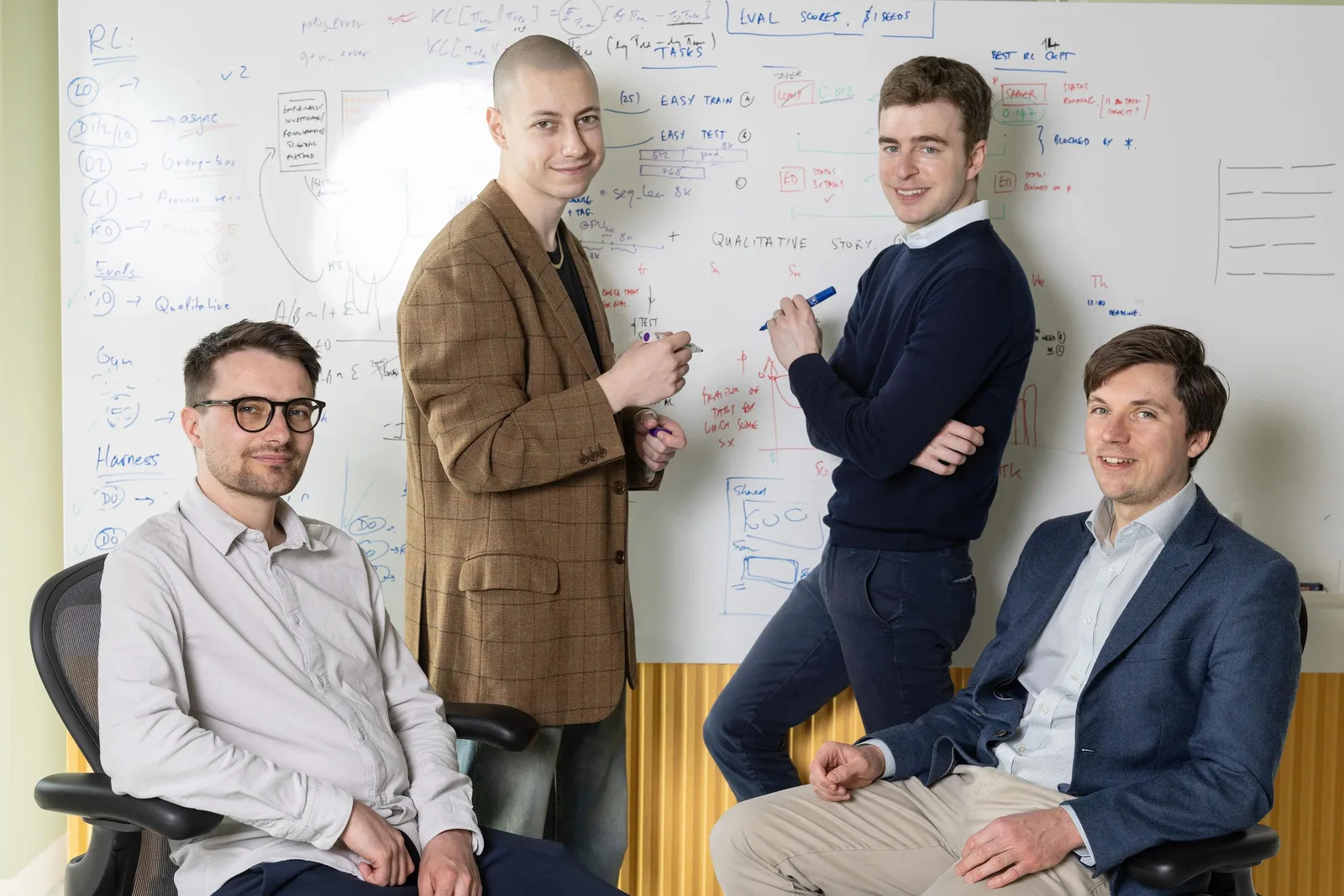
Beyond its technical innovation, Inherent emphasizes a collaborative organizational philosophy that reflects broader concerns in the AI community. All fourteen employees work in-person at King’s Cross, a district transformed by early DeepMind investments into a global hub for artificial intelligence research. Leadership has actively advocated for policy reforms regarding post-employment mobility, supporting initiatives to eliminate restrictive « garden leave » periods that currently hinder researcher movement between organizations. Looking ahead, the startup projects growth to approximately twenty to twenty-five team members by year-end, concurrently advancing work on world models and expanding its intellectual reach beyond immediate scientific domains. This trajectory positions Inherent as both a technical innovator and a catalyst for broader ecosystem transformation.