

The Privacy Play in a Crowded Market
The personal AI assistant space has exploded in recent months, with startups racing to embed themselves into everyday routines through text messages. From managing calendars and grocery lists to booking appointments and paying bills, these tools promise to streamline family life. But as consumers hand over increasing amounts of personal data, a growing tension is emerging between utility and privacy — and one company believes the latter could be its strongest competitive edge.
Unlike many enterprise-focused AI tools that have some form of data protection, this family-oriented assistant has achieved a rigorous independent security certification, signaling to users that it has formal controls in place to safeguard their information. For a product that needs access to calendars, emails, and potentially financial accounts, that signal matters. The founding team argues that trust isn’t just a nice-to-have — it’s the foundation of the entire business model, which relies on subscriptions rather than data monetization.
How Ollie Protects User Data
The assistant’s approach to security goes beyond certifications. It does not ask users to share their login credentials. Instead, when the assistant needs to access a website or complete a purchase on someone’s behalf, it spins up its own cloud-based browser and sends the user a link to a remote session. The same process applies to payments and transactions.
That said, the trade-off is real: users must log in for certain tasks, which can feel cumbersome. The CEO acknowledged that this is a work in progress, pointing to future developments like secure tokenization that could eliminate repetitive logins without sacrificing safety. « We want to find the right user experience that balances convenience and trust, » he said, describing the challenge as frontier territory.
A Stark Funding Gap
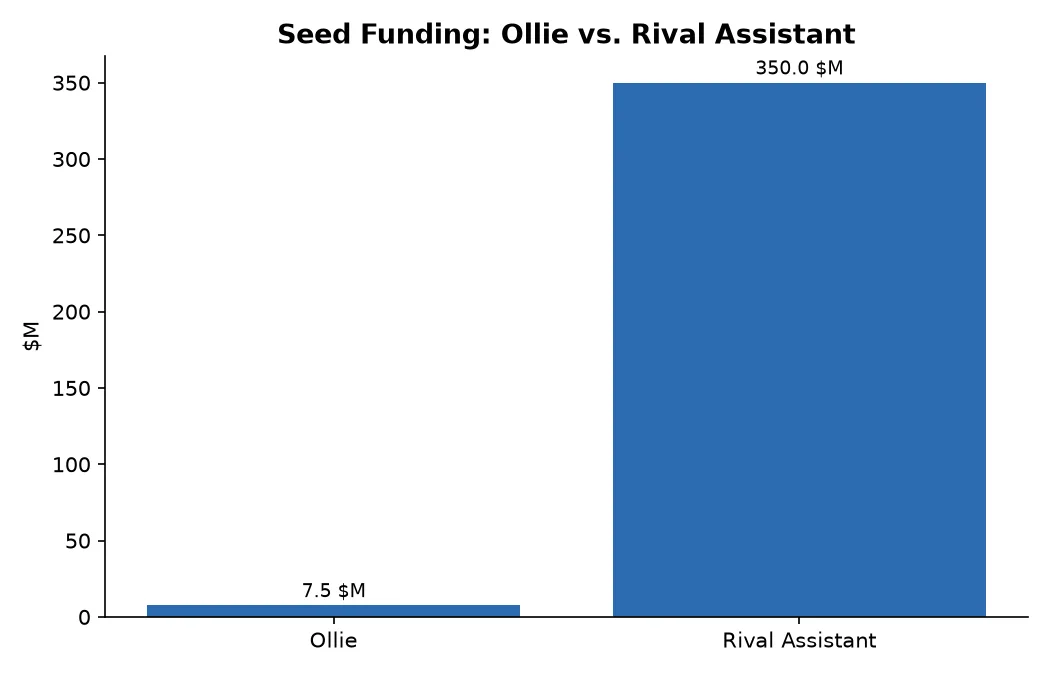
The competitive landscape for AI assistants is intense. Dozens of text-based assistants — including Poke, Fambot, Ohai, Folk, Saner.ai, and Tomo — compete for consumer attention, while others like Town, Lindy, and Reclaim.ai focus more on work, calendar management, and email. Then there’s the elephant in the room: a rival assistant that secured $350 million in funding at a $2.5 billion valuation before even launching its product.
By comparison, the seed funding raised by Ollie is modest. The gap between the two is enormous — roughly 46 to 1 — underscoring how difficult it is for a smaller, privacy-first startup to compete against a well-capitalized rival in a land grab market. The concern is whether consumers will care enough about privacy to choose a lesser-known tool over a heavily funded one.
Reliability Remains an Uphill Battle
Beyond funding, the broader challenge facing all AI assistants is reliability. These systems are inherently probabilistic and can produce inaccurate results — a serious problem when users depend on them for tasks like booking hotels or managing family schedules. One heavily funded competitor was found to quote incorrect hotel rates during early testing, while the privacy-focused assistant itself suffered an infrastructure outage during a review.
The founder was candid about the issue, noting that large language models are stochastic by nature and inherently unreliable. Building a defensive system that catches and prevents errors is an ongoing process — one that involves solving hundreds of small problems before the product can feel truly seamless. For now, consumers who give a new AI assistant one shot and find it broken are likely to move on permanently.
Whether Ollie’s privacy-first strategy can translate into lasting competitive advantage remains to be seen. But as the market matures, the question of who owns your data — and who gets to train models on it — may matter just as much as how smart the assistant actually is.