


A Divergence That Tells a Bigger Story
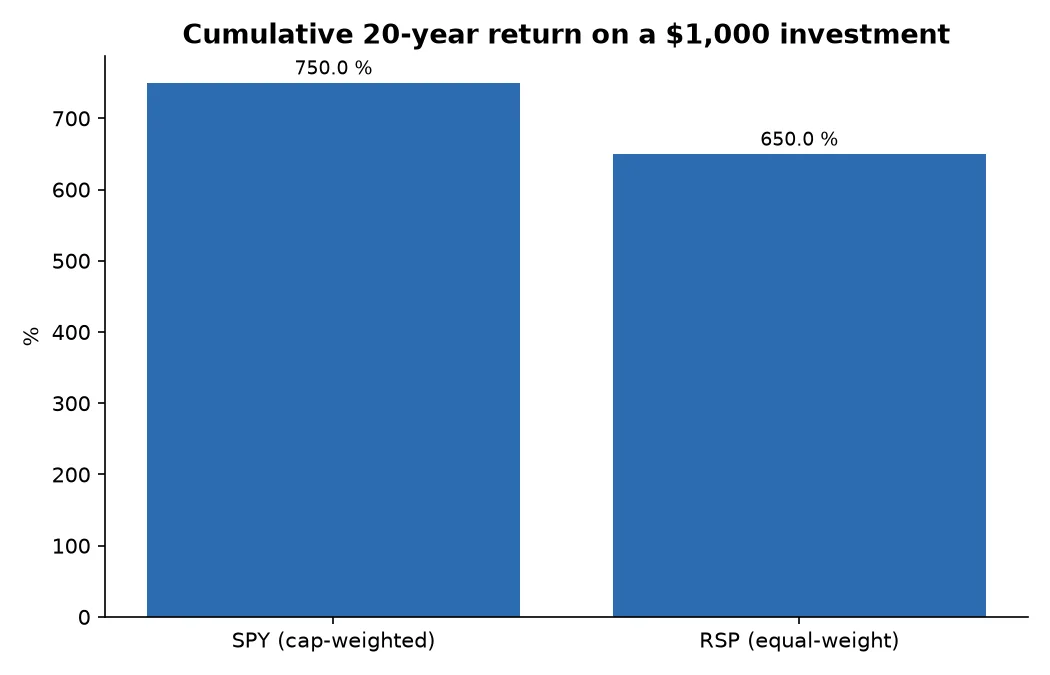
If you had invested $1,000 in the SPDR S&P 500 ETF Trust two decades ago, you would now hold close to $8,600 — a gain exceeding 750%. Put that same $1,000 into the Invesco S&P 500 Equal Weight ETF, and your stake would be worth less than $7,500, a gain under 650%. Both funds follow the same underlying index, yet their long-term returns have drifted apart by roughly 100 percentage points. The gap has widened dramatically in recent years, driven largely by the dominance of a handful of technology giants.
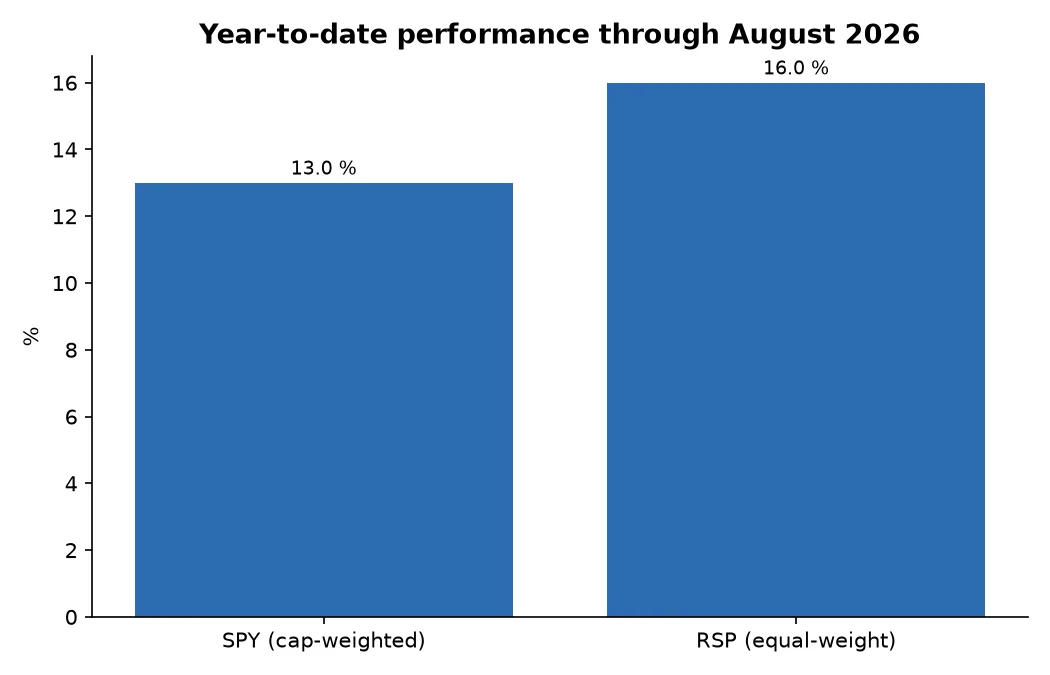
This year tells a similar but inverted story. Through late August 2026, the equal-weight version of the index is up more than 16% year to date, while the cap-weighted benchmark has gained roughly 13%. That is a historically unusual reversal, and it offers a useful lens for understanding how market breadth and concentration shape returns.
The Mathematics of Market Concentration
The cap-weighted S&P 500 gives larger companies outsized influence. The ten biggest names — spanning semiconductors, software, e-commerce, social media, and electric vehicles — collectively account for nearly 40% of the entire index. That means a relatively small group of stocks moves the benchmark more than the remaining 490 names combined.
This phenomenon is not a flaw; it is a feature of how market capitalization weighting works. But it has profound implications. Research in financial academia has repeatedly shown that a tiny fraction of publicly listed companies generates the vast majority of long-term equity returns. One widely cited study found that the best-performing 4% of U.S. listed companies since 1926 account for the net gain of the entire stock market, with all other stocks collectively matching the return of Treasury bills. Other research covering the period from 1990 to 2020 found that just 1% to 2% of public companies worldwide produced all shareholder value.
The Pareto Principle — the observation that roughly 20% of inputs drive 80% of outputs — actually understates how concentrated equity returns really are. In the stock market, the skew is even more extreme.
Why the AI Revolution Favors Cap-Weighting
The current concentration is not accidental. It reflects the compounding power of software and silicon in the digital age, where scaling happens faster than in any previous era of innovation. Since 2023, the accelerating capabilities of artificial intelligence have reinforced the market’s willingness to reward a small group of dominant firms. When investor confidence is high, capital flows toward the names perceived to benefit most from structural technological shifts — and the cap-weighted index simply lets those winners run.
The equal-weight index, by contrast, resets every quarter so that each constituent holds roughly the same 0.2% weight. This means it captures emerging winners earlier, before they grow large enough to dominate a market-cap benchmark. It is a broader net — but it also dilutes the impact of the very companies that have driven the bulk of returns.
As one market observer noted, the price-return correlation between the two versions of the index has dropped significantly during the 2020s. The link remains strong when macroeconomic fears dominate sentiment, but it weakens considerably when confidence is high and investors are chasing growth.
What This Means for Long-Term Investors
The equal-weight approach offers genuine diversification benefits and can outperform during periods when breadth widens and smaller stocks catch up. But history suggests that fighting the cap-weighted index — and the technology revolution powering it — has been a losing proposition over the long run.
For patient, diversified investors, the lesson is straightforward: concentration is not a bug of the market-cap-weighted index. It is the mechanism through which innovation compounds into extraordinary wealth creation. While the equal-weight version may lead in certain market environments, the structural tailwind of technological scaling has consistently favored the cap-weighted approach over multi-decade horizons.