


The Hedge That Stopped Working
American investors spent two generations trusting a simple equation: own equities for growth, own fixed income for safety, and let the two offset each other. The 60/40 allocation became the default setting for retirement accounts because, in theory, when equities declined, bonds would rise and soften the impact.
That cushion has worn thin. Earlier this year, the S&P 500 surrendered more than 4% in the first quarter, and the bonds meant to act as a shock absorber failed to do their job. Treasuries gave back their early gains and finished slightly in the red, while high-yield credit logged its first negative quarter since 2022. Equities and debt fell in tandem for the second time in four years — right when investors needed the balance most.
Why the Old Relationship Flipped
For much of the past two decades, the negative correlation between stocks and bonds made the balanced portfolio feel nearly invulnerable. In hindsight, that hedge relied on a very specific market regime: low and stable inflation paired with a Federal Reserve that had room to cut rates. Introduce a different inflation environment, and the dynamic reverses. The correlation between equities and bonds has swung from deeply negative a generation ago to positive today, meaning both halves of the portfolio can — and increasingly do — rise and fall together.
When that happens, an investor who thought they held two distinct assets may discover they are essentially making a single bet with two labels.
The Concentration Problem Inside Equities
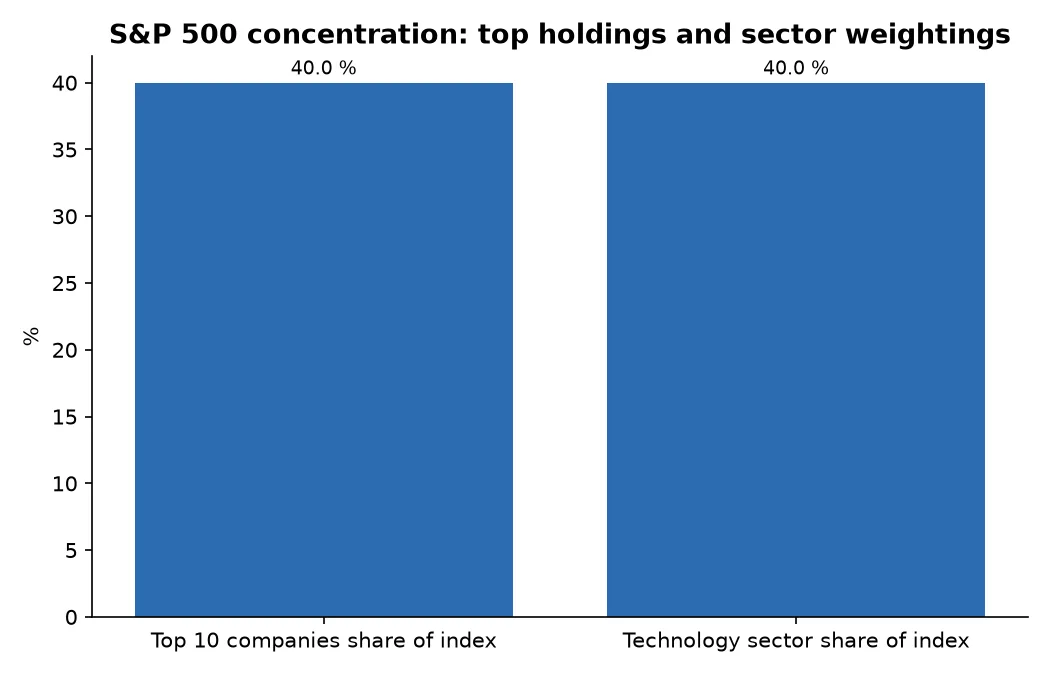
The erosion of diversification is not limited to the stock-bond relationship. The S&P 500 is trading near its most expensive valuation on record, approaching levels last seen during the dot-com bubble. And it has rarely been so narrow: the ten largest companies account for roughly 40% of the index — an all-time high — while the technology sector alone carries a weighting close to 40%.
A so-called broad index fund of 500 companies is, in reality, a concentrated wager on a handful of names priced for perfection. The pipeline of new listings, including prominent AI-focused firms, risks deepening that tilt, adding exposure to the same theme already dominating the index, much of whose value was built while these companies were still private.
Why Alternatives Behave Differently
So where can investors turn for the diversification they believed they already had? Increasingly, the answer points to private markets and other alternative assets — the space the most sophisticated institutions moved into years ago.
To understand why alternatives can behave differently, it helps to recognize that diversification only works when assets are driven by genuinely distinct forces. That is precisely what has disappeared from the traditional portfolio. Public equities and bonds now react to the same drivers: interest rates, liquidity conditions, and market sentiment. Many private investments do not.
The income from a senior secured loan depends on a borrower’s cash flow and sits ahead of equity in the capital structure. A stake in an established investment firm earns returns tied to the long-term expansion of private capital itself. Gains in a private company accumulate through years of operational execution, not through daily repricing driven by headlines.
Structure matters as well. Investors often view illiquidity as a drawback, but it also means capital is not forced to react every time markets panic. That has historically helped many private strategies avoid the sharp swings common in public markets — and even allowed patient owners to step in when others were compelled to sell.
The Door Is Opening
The typical university endowment now holds well over half its assets in alternatives, and pension funds for teachers, firefighters, and police officers have relied on private markets for decades to generate returns that public stocks and bonds alone could not deliver. Yet the teacher whose pension owns private-market exposure often cannot access that same allocation in her own 401(k).
That is starting to change. In 2025, an executive order directed regulators to expand access to alternatives inside workplace retirement plans, and in early 2026 the Department of Labor proposed a framework offering plan fiduciaries clearer protection when they add private markets to their offerings.
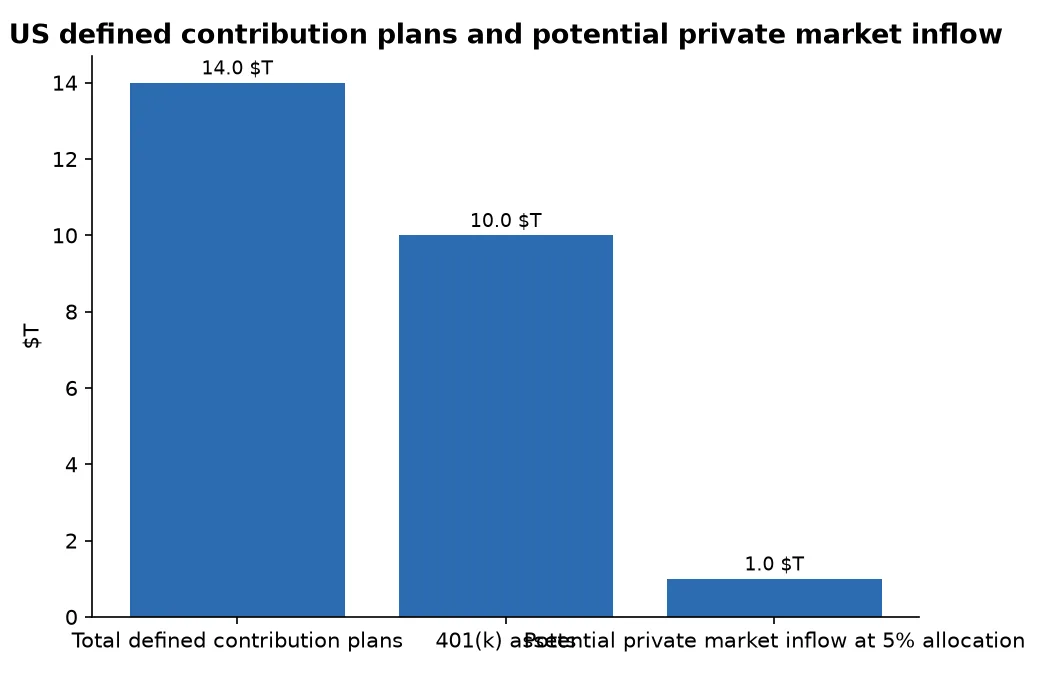
For the roughly $14 trillion sitting in American defined contribution plans — including $10 trillion in 401(k)s held by more than 70 million people — the current allocation to private markets is close to zero. Estimates suggest that even a modest 5% allocation could channel more than $1 trillion into private markets by the end of the decade.
The largest asset managers are already building vehicles to capture this shift, and the leading firms are doing more than simply repackaging old strategies. They are curating around specific themes and designing structures that offer investors greater liquidity, access, and optionality than traditional private funds have historically provided. Increasingly, how a vehicle is built may matter as much as what it holds.
The Next Chapter
None of this means stocks and bonds will disappear — they remain the foundation of how many people build wealth. But the idea that those two asset classes alone can diversify a portfolio is one that the past several years have thoroughly challenged.
Alternatives are moving from the periphery of the portfolio toward the center, and within reach of far more investors than ever before. The investors who recognize the regime has changed — before they are forced to — will be the ones best positioned for what comes next. The tools the most successful institutions have used for decades are becoming available more broadly, and the door is open. The 60/40 portfolio had a remarkable run; the next chapter will be written by those willing to look beyond stocks and bonds.