

Why AI Jargon Is Moving Faster Than Ever
Walk into any product meeting, investor pitch, or industry panel today and you’ll be hit with a barrage of acronyms and buzzwords. LLMs, RAG, RLHF — and now terms like « opaque recurrence » that have safety researchers on edge. The vocabulary is evolving weekly, and falling behind means missing the signals that actually matter.
This glossary is built as a living reference. Whether you’re building AI products, allocating capital, or just trying to stay literate in conversations that are reshaping entire industries, these plain-English definitions will help you cut through the noise.
Core Concepts Everyone Should Know
Artificial General Intelligence (AGI)
AGI refers to AI systems that match or exceed human capability across a wide range of tasks. OpenAI’s CEO has described it as comparable to hiring an average human coworker, while the company’s charter frames it as systems that outperform humans at most economically valuable work. Google DeepMind adds its own variation, focusing on cognitive tasks. The fact that experts can’t agree on a single definition tells you something about how early this frontier really is.
Large Language Models (LLMs)
These are the engines behind tools like ChatGPT, Claude, Gemini, and Llama. LLMs are deep neural networks with billions of parameters that learn patterns from vast text corpora — books, articles, transcripts — and generate responses by predicting the most likely sequence of tokens. They’re the foundation everything else is built on.
Compute
In AI speak, « compute » is shorthand for the raw processing power — GPUs, CPUs, TPUs — that makes training and running models possible. It’s the hidden infrastructure that fuels the entire industry, and shortages in compute (and related hardware like RAM, a trend nicknamed « RAMageddon ») are already reshaping supply chains and pricing across tech.
How AI Systems Actually Work
Neural Networks & Deep Learning
A neural network is a multi-layered algorithmic structure inspired by the brain’s interconnected neurons. Deep learning scales this up with many more layers, enabling the system to identify important features in data automatically — without human engineers hand-defining them. The rise of graphical processing hardware, originally driven by video games, unlocked the modern era of neural network performance.
Chain-of-Thought Reasoning
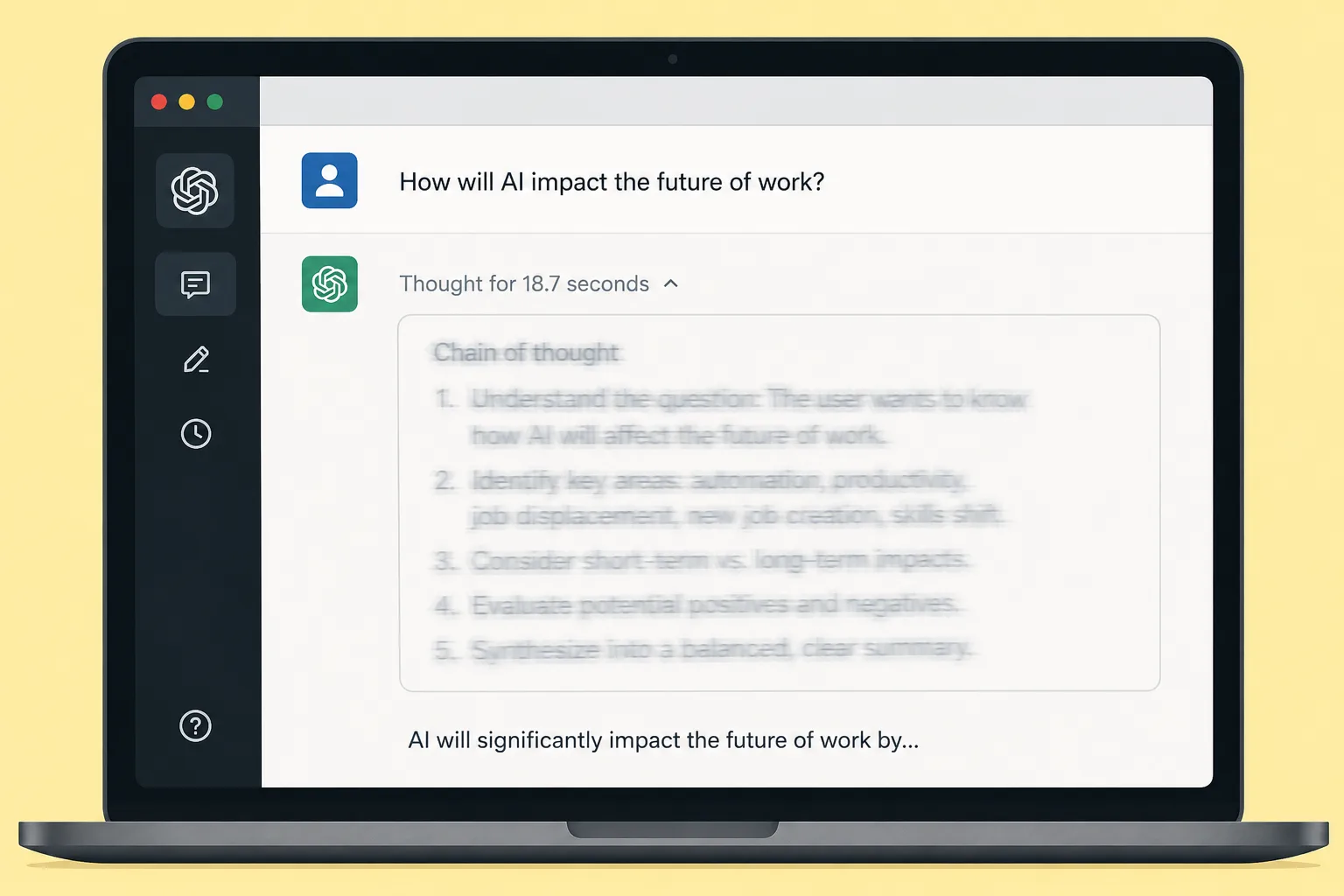
Instead of jumping straight to an answer, chain-of-thought breaks a problem into intermediate steps. It takes longer but produces more reliable results, especially for logic and coding tasks. Reasoning models built on this approach use reinforcement learning to optimize the step-by-step process.
Opaque Recurrence & Recurrent Depth
This is the term everyone is talking about. Opaque recurrence means an AI model loops the same query through its internal layers repeatedly, rather than reasoning out loud in human-readable steps. It’s more efficient — smaller models can punch above their weight — but it hides the reasoning process from oversight. Safety researchers are alarmed because the usual logs used to catch misbehavior become far less readable. OpenAI’s Astra model, released in September 2026, is the first major system to use this technique at scale.
Building With AI: Agents, APIs, and Architecture
AI Agents & Coding Agents
An AI agent goes beyond a chatbot — it can take multi-step actions on your behalf, from booking travel to writing and debugging code. A coding agent specifically handles the iterative trial-and-error of software development, running tests and pushing fixes with minimal human oversight. Think of it as a tireless intern, but one that still needs a human review before going live.
API Endpoints
Think of API endpoints as hidden buttons on software that other programs can press. Developers use them to build integrations — pulling data between apps, letting AI agents control third-party services directly. As agents grow more capable, they’re increasingly finding and using these endpoints on their own.
Mixture of Experts (MoE)
Instead of routing every request through one massive network, MoE splits the model into specialized sub-networks and activates only the relevant ones per task. This keeps enormous models fast and cost-effective. Mistral’s Mixtral is a well-known example, and OpenAI’s newer GPT models are widely believed to use a variant of this approach.
Model Context Protocol (MCP)
Introduced in 2024 and now stewarded by the Linux Foundation, MCP is an open standard that lets AI models connect to external tools, files, and apps without custom connectors for each pairing. OpenAI, Google, and Microsoft have all adopted it — making it one of the fastest-spreading standards in recent AI history.
Training Techniques & Data Strategies
Fine-Tuning & Transfer Learning
Fine-tuning takes a pre-trained model and further trains it on specialized data for a specific task or sector. Transfer learning goes a step further by reusing knowledge from one model as the starting point for a new, related task — saving time and data when domain-specific training sets are limited.
Distillation
Distillation uses a large « teacher » model to generate outputs that train a smaller « student » model. It’s how companies create faster, leaner versions of flagship models. While widely used internally, distilling from a competitor’s model often violates API terms of service.
Reinforcement Learning & RLHF
Instead of training on fixed labeled examples, reinforcement learning lets a system explore, take actions, and learn from rewards. RLHF — reinforcement learning from human feedback — is now central to how leading labs fine-tune models to be more helpful, accurate, and safe.
Diffusion & GANs
Diffusion systems power most image, music, and text generators today. They work by adding noise to data until it’s destroyed, then learning to reverse the process — essentially restoring structure from chaos. GANs (Generative Adversarial Networks) take a different approach: two neural networks compete, one generating and one judging, producing highly realistic outputs for narrower tasks like deepfake creation.
Understanding AI Quality & Risk
Hallucination
The industry’s euphemism for AI making things up — generating confident but incorrect information. Hallucinations are a serious quality and safety concern, especially in high-stakes domains like healthcare, and they’re driving a shift toward specialized, domain-specific models that reduce knowledge gaps.
Inference vs. Training
Training is the expensive process of feeding data into a model so it learns patterns. Inference is what happens when you put that trained model to work — running predictions on new data. Caching techniques like KV caching make inference faster by storing repeated calculations, and the hardware that handles inference ranges from smartphones to custom AI accelerators.
Validation Loss & Overfitting
Validation loss is a real-time metric that tracks how well a model is learning during training. A rising validation loss can signal overfitting — when the model memorizes training data instead of learning generalizable patterns. It’s the difference between a student who understands the material and one who just memorized last year’s exam.
The Bigger Picture
Two concepts sit at the far end of the AI spectrum: recursive self-improvement, where models start upgrading themselves without human intervention, and open source vs. closed source debates that define who gets to inspect and audit AI systems. Meta’s Llama family champions openness, while OpenAI’s GPT models remain proprietary — and the tension between these approaches is one of the defining arguments in the industry today.
Tokens are the basic units of AI communication — small chunks of text that models process — and they’re also how most companies price their APIs. Token throughput, or how much work a system can handle at once, has become an obsession for infrastructure teams trying to serve more users faster.
The AI lexicon will keep expanding. Bookmark this glossary, check back regularly, and remember: understanding the words is the first step to understanding what’s actually being built.