


The real difference isn’t the portfolio size — it’s the system
What separates financially secure retirees from the rest isn’t necessarily a larger nest egg. It’s a cluster of disciplined habits built over decades. The encouraging takeaway: you don’t need a seven-figure balance to adopt these behaviors. Most are available to any saver willing to be intentional.
Start the savings engine early — and never stop
The wealthiest retirees treated 401(k) contributions as a non-negotiable bill, not an optional expense. By committing $20,000 annually from age 30 to 65 at a 7% return, the math produces roughly $2.7 million — and those who added catch-up contributions after 50 built even larger cushions. What mattered most was automation: contributions rose with each raise, and nobody paused them during market drops.
Roth conversion strategy in your 60s
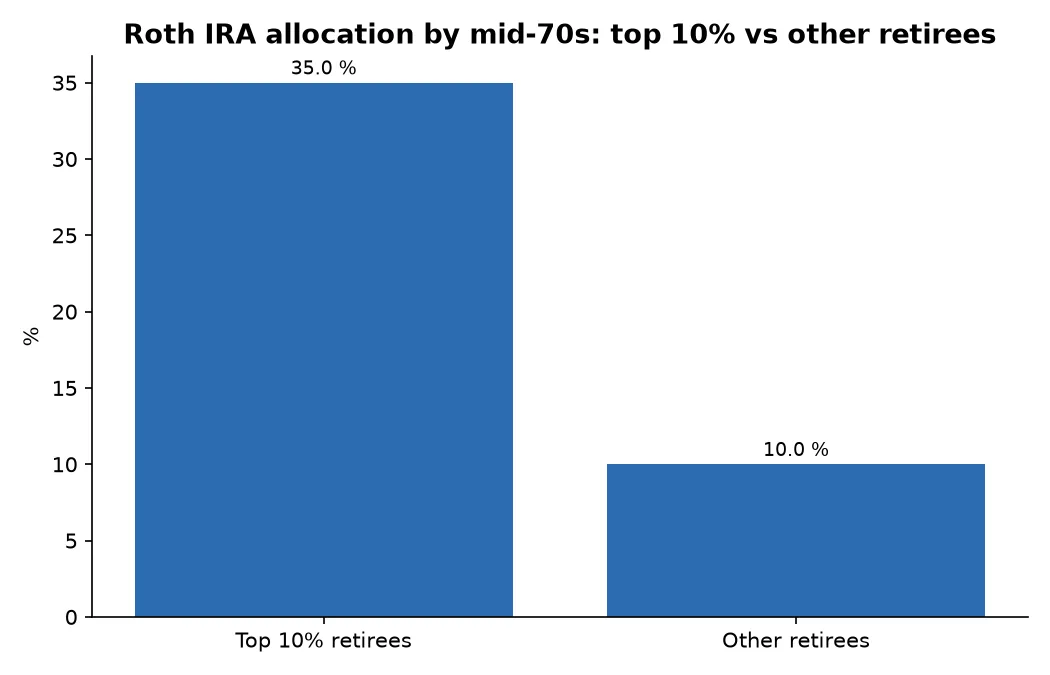
A counterintuitive move pays off handsomely: converting traditional IRA assets to Roth accounts during the low-income window between retirement and Social Security claiming. Pay taxes now at a modest bracket, then enjoy tax-free withdrawals forever — with no required minimum distributions, no IRMAA surcharge triggers, and tax-free inheritance for beneficiaries. By their mid-70s, these retirees hold about 35% of assets in Roth, compared to roughly 10% for the broader retiree population.
Build a volatility buffer
Wealthy retirees aren’t stressed by market swings because they never get forced to sell at the bottom. They maintain two to four years of living expenses in cash equivalents — high-yield savings, money markets, short-term CDs, Treasury bills. Research indicates that holding two to three years of reserves improves the probability of a 30-year retirement by 15 to 20 percentage points.
Delay Social Security to 70
The top earners overwhelmingly wait until age 70 to claim Social Security, funding early retirement years from other income sources. Each year of delay past full retirement age boosts the benefit by roughly 8% — a guaranteed, inflation-adjusted return unmatched by any other vehicle. For high earners, that can translate to $10,000 or more annually for life.
Professional guidance as a cost, not an expense
A major 2024 study found that working with a financial adviser adds approximately 3.75% in net annual value through planning, coaching, tax strategy, and portfolio oversight. These retirees typically choose fee-only or fee-based fiduciaries — compensated by transparent fees rather than product commissions — so advice isn’t tilted toward highest-commission products. They view advisory fees of 0.5% to 1.5% as protection against expensive mistakes.
Segment essential vs. discretionary spending
Wealthy retirees draw a hard line between non-negotiable costs — housing, healthcare, food, insurance — and discretionary ones like travel and dining. Essentials are covered by Social Security, pensions, and bond income; discretionary spending comes from portfolio withdrawals. In a downturn, they can trim discretionary spending by 30% to 50% for a year or two, avoiding the worst time to sell equities.
Medicare and long-term care: plan early
These retirees treat Medicare enrollment as a strategic exercise, not paperwork. They typically favor Medigap plans for lower out-of-pocket risk and broader provider access, and they monitor income before 65 to avoid IRMAA surcharges. Most critically, they address long-term care coverage in their 50s, when premiums are significantly lower.
Tax bracket arbitrage as a year-round discipline
The most distinctive trait: obsessive attention to marginal tax rates. They fill low brackets with Roth conversions, realize capital gains at 0% when income permits, avoid IRMAA cliffs, bunch deductions in alternating years, and use qualified charitable distributions after 70½. Over a 30-year retirement, this discipline can shave $100,000 to $200,000 off the lifetime tax bill.
Systematic rebalancing and estate maintenance
Wealthy retirees rebalance on a schedule, trimming surging equities into bonds and buying into crashes — never panic-selling after declines or chasing rallies. They also review estate documents every three to five years and after major life events, keeping beneficiary designations current since these override wills.
The bottom line
The common thread? These retirees didn’t get wealthy by accident. They built systems — automated savings, tax-efficient withdrawal sequencing, professional oversight, and regular plan reviews — that compound over decades. The remarkable part: most of these habits scale to any balance level. Retirement confidence isn’t about nest egg size. It’s about how strategically you manage what you have.