


The Concentration Problem in Your « Diversified » Stock Portfolio
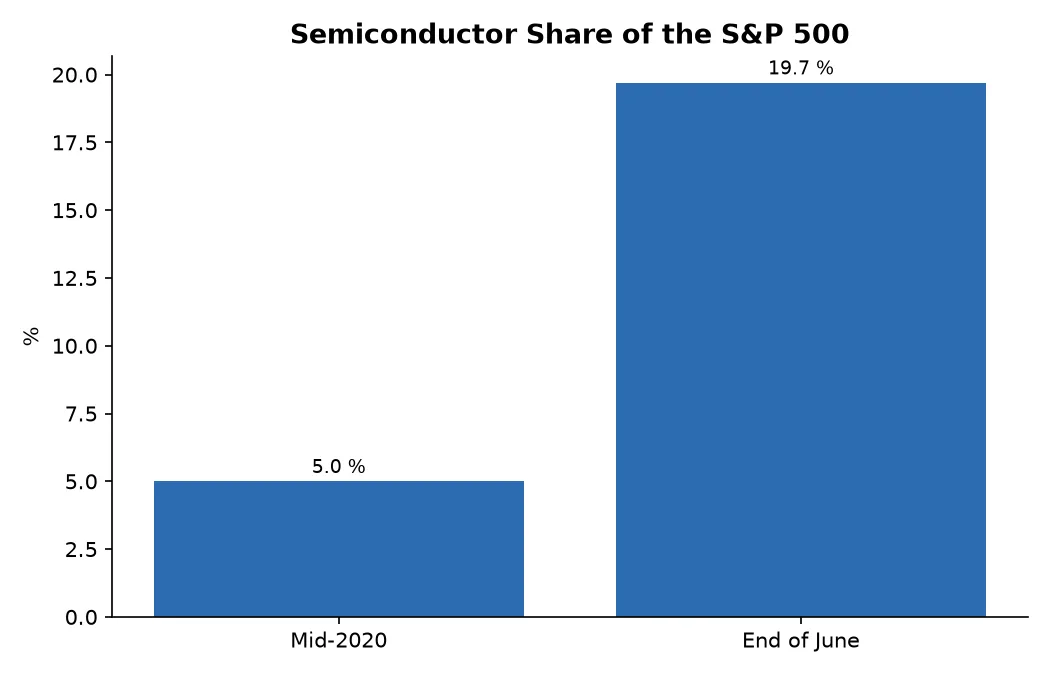
Owning an S&P 500 index fund might feel like spreading your money across 500 companies. In reality, a handful of names now dominate returns. Semiconductor stocks alone accounted for nearly one-fifth of the entire index by mid-year, a share that has ballooned from roughly 5% just a few years earlier. The effective diversification you get from the S&P 500 today resembles what you’d achieve with about 50 equally weighted stocks — not 500.
That concentration matters because it means your equity allocation may be riding on the fortunes of a very small group of companies, mostly in the same sector and exposed to the same economic forces.
When Bonds Stop Buffering
The bond side of the equation has its own vulnerability. The entire premise of pairing stocks with bonds rests on them moving in opposite directions. That relationship broke down spectacularly in 2022, when both asset classes declined simultaneously, producing one of the worst annual performances for a balanced portfolio in decades.
More recent data confirms that stocks and bonds have been moving more in tandem than at any point in the past decade. The traditional buffer that bonds once provided has weakened significantly, leaving investors without the downside protection they expected.
The Real Asset Alternative
The core issue isn’t that investors lack enough holdings — it’s that many of those holdings are exposed to the same underlying risks. The answer may lie in real assets: physical, tangible investments that derive their value from concrete economic activity rather than corporate earnings reports.
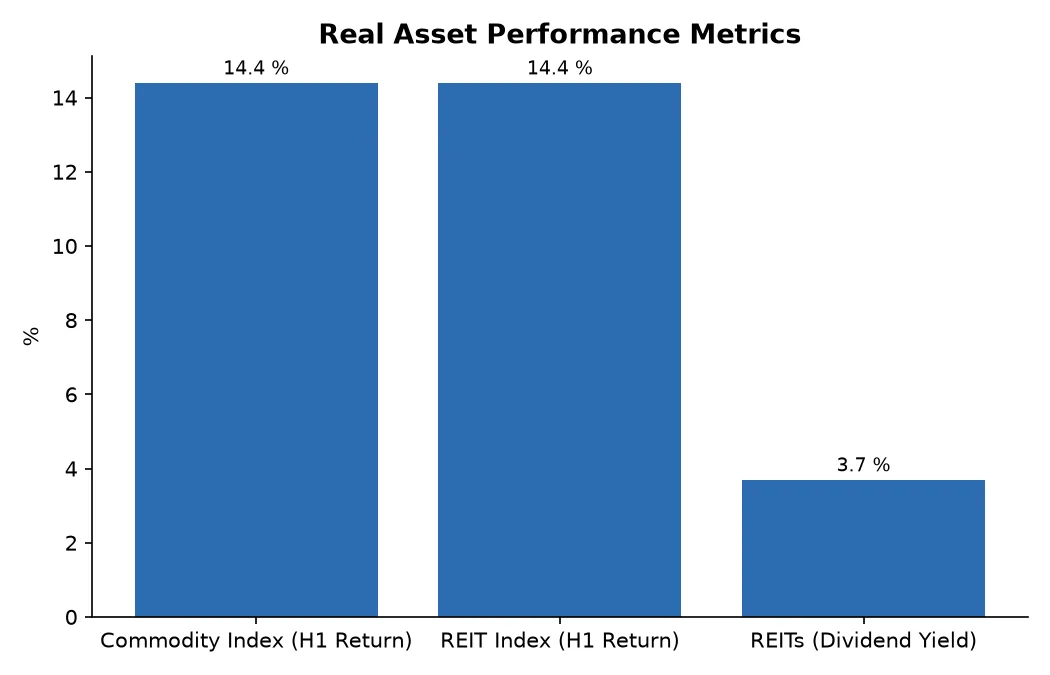
Real assets had a standout first half of the year. A broad commodity index returned 14.4%, marking one of its strongest openings on record. Meanwhile, equity REITs — which own and operate properties like warehouses, cell towers, and data centers — also gained 14.4% through late June, beating the broader stock market while delivering a 3.7% dividend yield along the way.
Why Real Assets Are Tied to Megatrends
What makes real assets compelling right now is their deep connection to long-term structural shifts. The same AI boom that has concentrated the stock market is also driving massive demand for physical infrastructure. Electricity consumption from data centers grew 17% last year and is projected to roughly double again by 2030, expanding at nearly six times the rate of overall electricity demand.
Every AI system requires power generation, transmission networks, land, cooling equipment, and critical minerals. Investors who hold broad stock index funds participate in the companies designing chips and software, but much of the physical infrastructure enabling AI growth sits outside those indexes. Real assets offer exposure to an entirely different set of return drivers.
From toll roads and airports to nursing facilities and copper wiring, real assets are embedded in the everyday economy. Their income streams come from tolls, leases, rents, and regulated utility rates — revenue sources that behave differently from tech company earnings.
How to Add Real Assets to Your Portfolio
Individual investors can access real assets through low-cost index funds and ETFs, typically across four broad categories: commodities, real estate investment trusts (REITs), infrastructure, and natural resources. Rather than betting on a single asset like gold, spreading allocations across these sectors can help, since each responds differently to economic conditions.
Tax efficiency is worth considering. REIT dividends are generally taxed as ordinary income, and commodity funds can be less tax-efficient than traditional equity funds. Holding these assets in tax-advantaged accounts like IRAs can help mitigate that drag.
Managing Expectations
Real assets are not a magic fix. They are not a replacement for stocks and bonds, and they are not immune to sharp swings. A commodity index that surged in the first half of the year ended June roughly 14% below its May peak, reminding anyone who bought near the top that drawdowns happen fast.
The smart approach is to set a target allocation you can hold through different market cycles, rebalance regularly, and resist the urge to chase whichever asset class is hottest at the moment.
In 1952, a mathematician gave rigorous form to an old piece of wisdom: don’t put all your eggs in one basket. More than seven decades later, the principle still holds — but the baskets have changed. The question for today’s investors is whether the ones they own truly respond to different economic forces, or whether they’re all exposed to the same storm.