

Circleback Goes Free to Stand Out in a Crowded Market
The AI-powered meeting note-taker space has become increasingly competitive in recent weeks. Dictation app Wispr launched its own note-taking and scheduling tool, and Calendry integrated a similar feature into its platform. Meanwhile, dedicated players such as Granola, Read AI, and Fireflies have collectively raised millions in venture funding. Against this backdrop, Circleback is making a bold move: offering its product at no cost to attract a wider user base.
What the Free Plan Includes
The new free tier allows users to transcribe an unlimited number of meetings, though transcript history is capped at the most recent 30 days. Subscribers on the free plan can record meetings, use the mobile app and Apple Watch integration, query transcripts through built-in AI, and connect the service with Linear and Slack. Notably, Circleback will not spend on traditional advertising channels like Google or Meta ads — the free tier itself will serve as its primary customer acquisition channel.
How the Pricing Compares
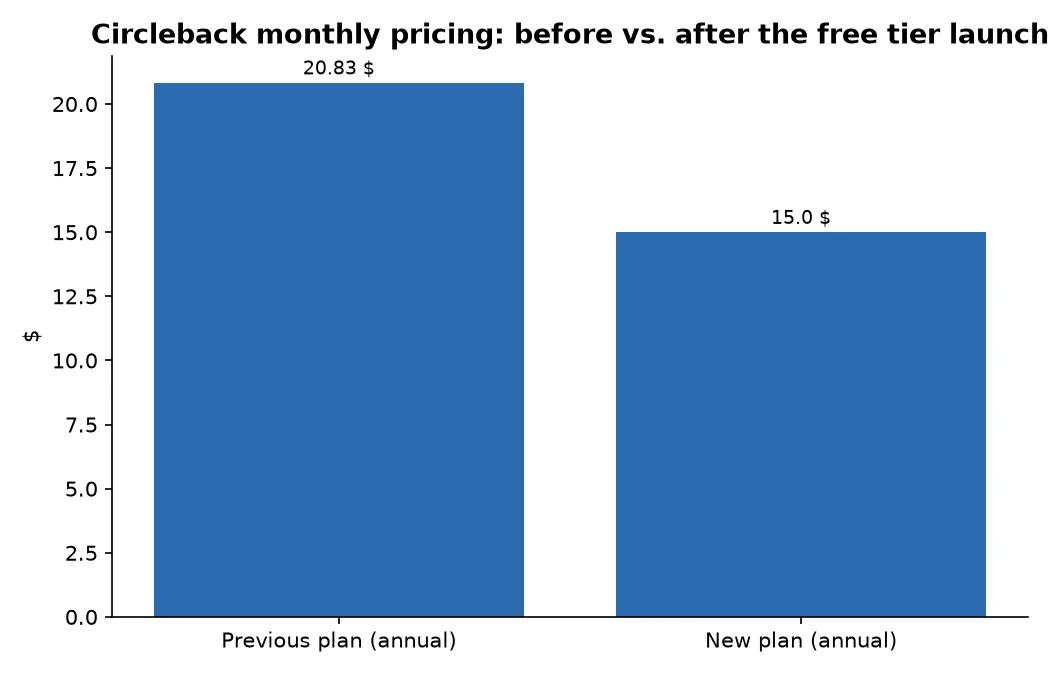
Before this change, Circleback had no free option and its entry-level plan started at $20.83 per month when billed annually. The new paid tier, which unlocks all integrations, unlimited transcript history, and full API and MCP access, now begins at $15 per month on an annual billing cycle. This represents a meaningful price reduction designed to convert free users into paying customers over time.
Profitable Growth Without External Pressure
Founded in 2023 by Ali Haghani and Kevin Jacyna, Circleback raised $2.5 million in 2024 and has been profitable since. With a lean team of eight employees, the company reports annual recurring revenue exceeding $1 million per employee, putting its total ARR at roughly $8 million. Despite receiving investor interest, leadership says it is not actively seeking additional funding, citing no obstacles in its growth path.
A Strategy Built on Product Quality
Haghani explained that the company previously offered only a limited trial period, which led to significant user drop-off. By removing that barrier entirely, Circleback aims to put its product in front of far more people. « If we open the gates and let more people use the product, that brings Circleback in front of more people. Then we’re very good at making the product good and monetizing those users, » he said. The company’s confidence appears well-placed: it claims to regularly win customers against much larger organizations in terms of both headcount and funding, and Haghani noted that the startup would only reconsider fundraising if it encountered a problem that capital could solve.