


The Case for the Harness
Most people assume that selecting the most capable AI model determines overall system success. However, cutting-edge research challenges this assumption completely.
Performance Breakthrough
Nvidia‘s latest study illustrates that the wrapper code—rather than raw model capability—is the primary driver of performance in agentic systems designed for long-horizon tasks.
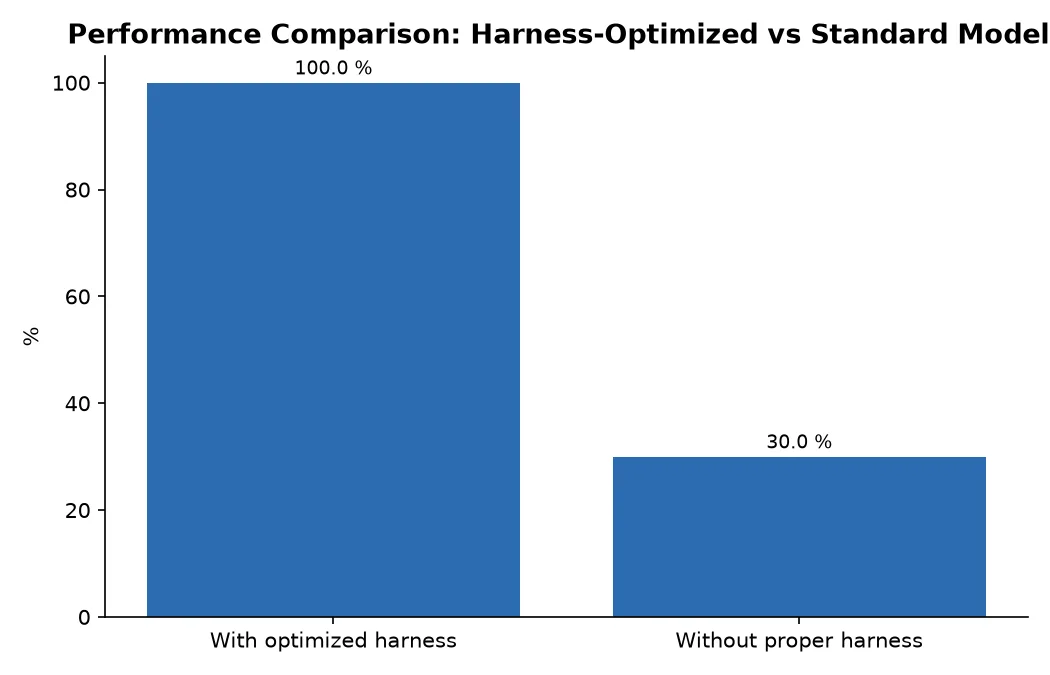
When researchers applied a carefully tuned harness to their Claude Opus 5 model, they achieved a perfect 100% score on the ARC-AGI-3 benchmark. Without such optimization, the same model managed only a modest 30% accuracy.
Supervisory Agents Provide Critical Guidance
The team introduced a « supervisor » component within the harness that acts as a runtime director. When the main agent encounters obstacles or drifts away from the desired path, this auxiliary component provides steering cues to keep work on track.
This finding underscores a strategic priority for developers: invest heavily in architectural design and tool integration before optimizing individual model parameters.
Broader Implications for the Industry
Beyond Nvidia, the study supports a broader trend where open-source frameworks enable greater user control. Organizations can now experiment with alternative implementations whose performance may vary dramatically based purely on the surrounding harness rather than the model weights themselves.