

The Limits of Traditional Market Terminology
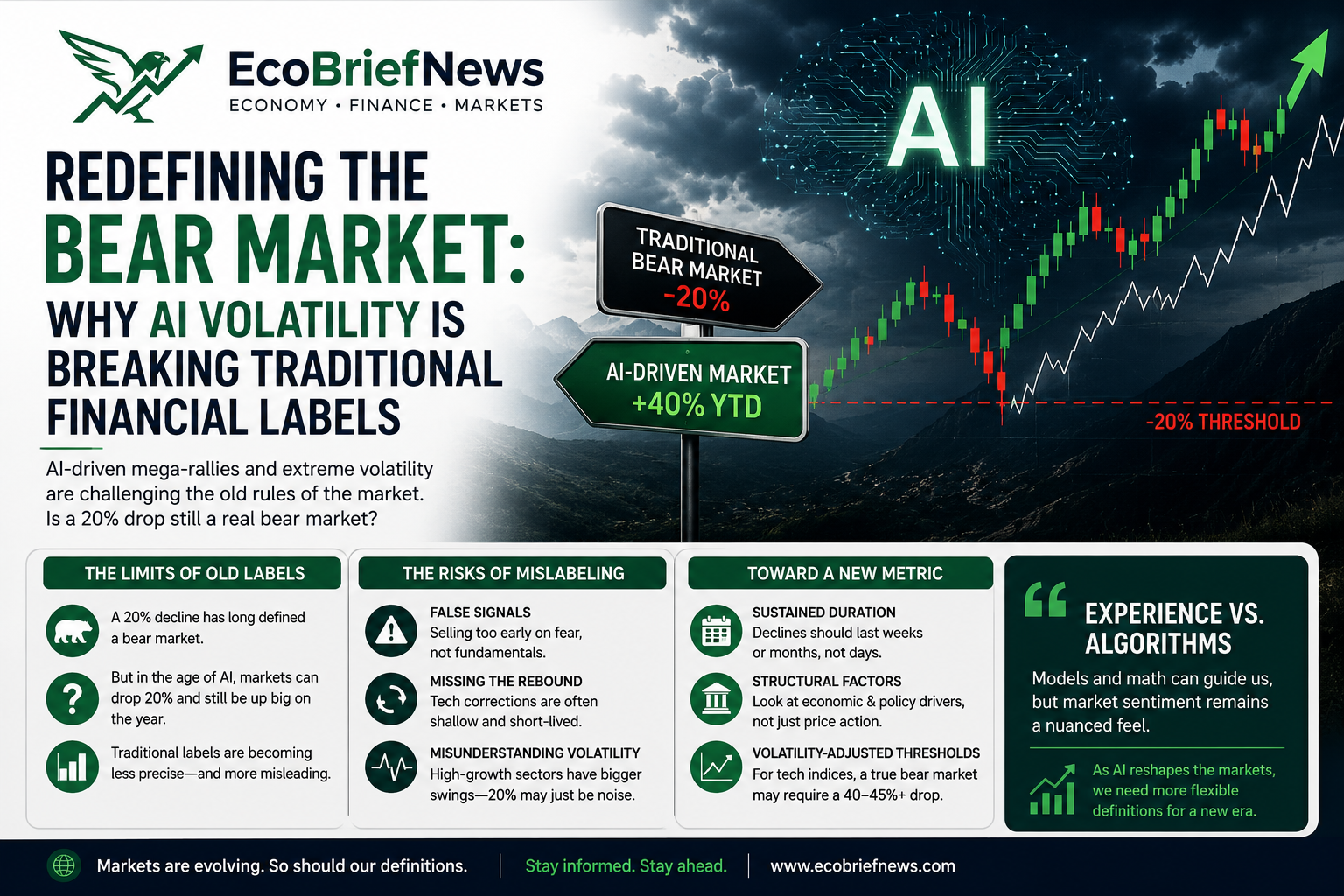
For decades, Wall Street has relied on a simple rule of thumb: a 20% decline from recent highs signals the start of a bear market. This clear-cut definition has helped investors categorize market sentiment and prepare for potential downturns. However, the explosive growth and extreme volatility driven by the artificial intelligence boom are pushing this traditional nomenclature to its breaking point.
We are increasingly seeing a phenomenon where major indices experience significant daily swings and even hit the technical threshold for a ‘bear market,’ yet remain substantially higher on a year-to-date basis. This creates a confusing landscape for investors trying to distinguish between a temporary correction and a fundamental shift in market direction.
When ‘Bear Markets’ Look Like Bull Runs
Recent movements in semiconductor-heavy indices and major tech-focused markets in Asia have highlighted this contradiction. Some key benchmarks recently dipped into what would traditionally be called bear territory. Yet, because of the massive parabolic gains seen over the previous year, these same indices remained up significantly for the year despite the recent pullbacks.
This discrepancy raises a critical question: if an index falls 20% but is still up 40% annually due to a tech surge, is it truly a bear market? Many strategists argue that applying old labels to highly volatile, high-growth sectors is imprecise and potentially misleading.
The Risks of Mislabeling
The debate is more than just semantic; it has real-world implications for portfolio management. Relying too strictly on traditional labels can lead to several risks:
- False Signals: Investors might sell off assets prematurely, fearing a long-term decline that isn’t actually supported by economic fundamentals.
- Missing the Rebound: In tech-heavy sectors, corrections are often shallow and followed by rapid recoveries. Those who exit based on a ‘bear market’ label risk missing the next leg of an AI-driven rally.
- Misunderstanding Volatility: High-growth sectors naturally possess higher annualized volatility. A standard 20% drop might simply be ‘noise’ within the context of a sector that regularly sees 40% or 50% swings.
Searching for a New Metric
As the market evolves, several alternative approaches are being discussed to better capture the reality of modern trading. Instead of a fixed percentage, some analysts suggest that a true bear market should be defined by:
Sustained Duration: A decline should be confirmed by lasting through multiple weeks or months, rather than being a sharp, short-lived spike in volatility.
Structural Factors: A real bear market might require negative underlying economic drivers, such as peaking economic cycles or aggressive interest rate shifts, rather than just price action.
Volatility-Adjusted Thresholds: Rather than a flat 20%, some propose that a decline must exceed a specific index’s historical volatility to be considered a true bear market. For highly volatile tech indices, this threshold might actually be closer to 40% or 45%.
Conclusion: Experience vs. Algorithms
While new mathematical models and moving averages can provide better guidance, many veteran traders suggest that market sentiment remains a nuanced ‘feel’ that numbers alone cannot capture. As AI continues to reshape the landscape, the financial world may have to move away from tidy definitions toward a more flexible understanding of market cycles.