

Inflation Stays at 3% Despite Modest Improvements
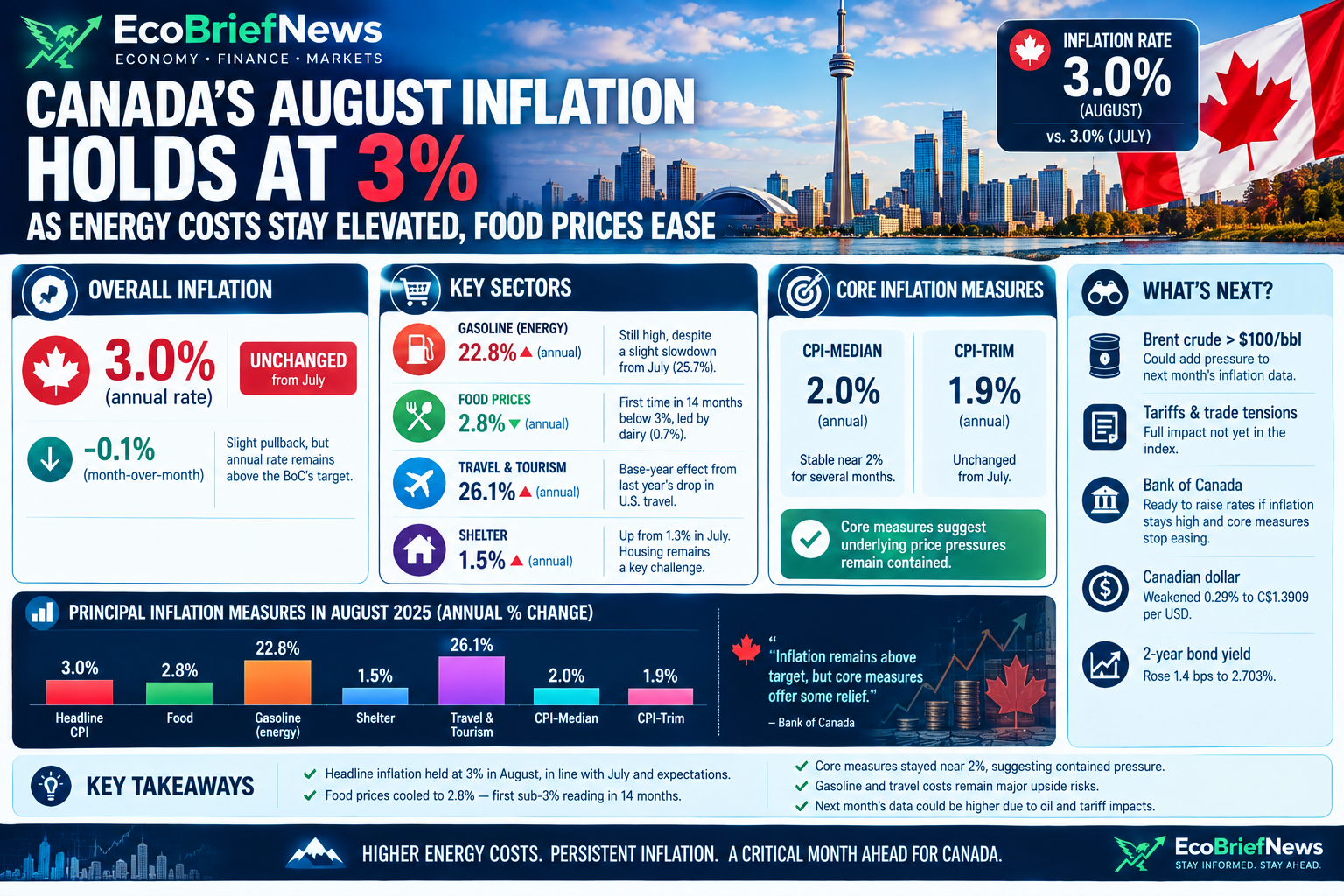
Canada‘s consumer price index remained unchanged at an annual rate of 3% in August, matching July’s level, according to freshly released government data. The reading suggests that inflationary forces continue to hover above the central bank’s preferred target range, even as pockets of relief emerge in the cost of everyday goods.
On a month-over-month basis, consumer prices actually edged down by 0.1%, a slight pullback that indicates the annual figure was largely sustained by strong year-ago comparisons and stubbornly high energy costs rather than broad-based acceleration.
Gasoline Prices Still Surging, Food Inflation Breaks Through
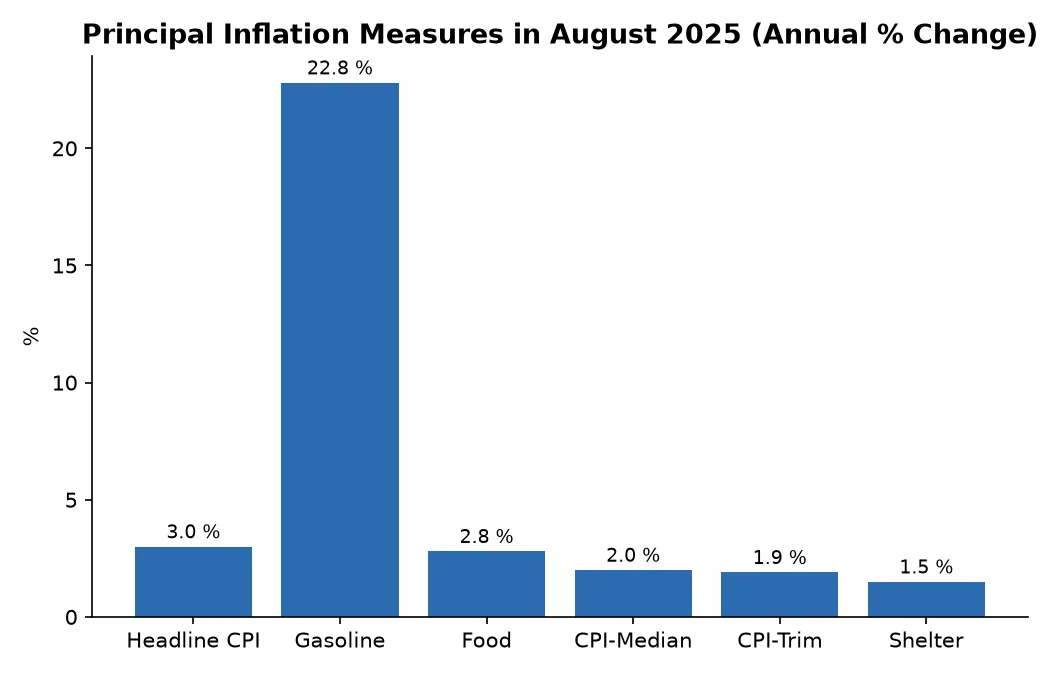
Fuel remains the dominant engine of inflation. Although gasoline costs dipped marginally from July levels, they were still climbing at an annual pace of 22.8% — a slight deceleration from July’s 25.7% rate, but enough to keep energy as the single largest contributor to the headline number.
Food prices delivered a more promising signal for policymakers and shoppers alike. Annual food inflation eased to 2.8%, marking the first time in 14 months that this category fell below the 3% mark. Dairy products spearheaded this improvement, with prices rising just 0.7% annually compared with a 3.1% jump in July. Cheese and yogurt were the primary drivers behind the dairy slowdown, reflecting more normalized supply chains in that segment.
Core Inflation Measures Remain Reassuringly Stable
Underlying price pressures told a calmer story. The CPI-median, which captures the midpoint of the inflation distribution, held firm at 2%. CPI-trim, which filters out the most extreme price movements, came in at 1.9% — identical to July’s reading.
Both core measures have been lingering near the 2% level for several months, lending credibility to the view that the crude oil surge has not yet leaked into a wider spiral of consumer prices. This stability is a critical factor as the central bank weighs its policy options.
Travel Costs Spike, Shelter Pressures Build
One category that surprised to the upside was travel and tourism, where prices leaped 26.1%. The surge was largely a base-year effect: Canadian travel spending had collapsed during the same period a year earlier, primarily because of a sharp drop in cross-border trips to the United States. With that low comparison now rolling off the books, the category is snapping back forcefully.
Shelter costs, encompassing rent and mortgage interest, ticked up slightly to 1.5% from 1.3% in July, a reminder that housing affordability remains an ongoing challenge for Canadian households.
What the Road Ahead Looks Like
All eyes are now shifting to September’s data. Benchmark Brent crude has pushed past $100 per barrel this month, and the full-month consequences of recent tariff developments — including new U.S. trade policies and Canada’s retaliatory countermeasures — have yet to be reflected in the index. Next month’s reading could therefore paint a considerably more inflationary picture.
The Bank of Canada has made clear it would not hesitate to raise interest rates repeatedly if inflation stays elevated and begins to drag on those closely watched core measures. The institution is committed to keeping prices near the midpoint of its 1% to 3% target range.
Markets already appear to be adjusting. Following the data release, the Canadian dollar weakened by 0.29% against the U.S. dollar, trading at C$1.3909 per dollar. Government bond yields firmed, with the two-year benchmark rising 1.4 basis points to 2.703%, suggesting investors are pricing in a slightly more hawkish policy path ahead.
Key Takeaways
- Headline inflation held at 3% in August, in line with July and analysts’ expectations.
- Food prices cooled to 2.8% annually — the first sub-3% reading in 14 months — led by dairy.
- Core measures (CPI-median and CPI-trim) stayed near 2%, suggesting contained underlying pressure.
- Gasoline prices remain elevated at 22.8% annually despite a slight pullback from July.
- Next month’s data carries risk to the upside due to Brent crude above $100 and tariff impacts.